
The following is the English transcript of a sermon preached for Spanish Holy Eucharist on the feast of St. Ignatius of Antioch, October 17, 2017. It was preached at the Chapel of the Apostles in Sewanee, TN.
For the video of the sermon, click here.

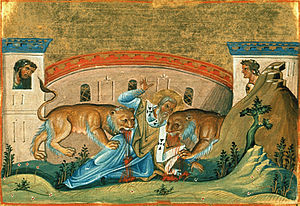
Today we remember Ignatius of Antioch, bishop and martyr. Ignatius is best remembered for his letters to churches in Asia Minor and to a fellow bishop, Polycarp, on his way to his death in Rome, accompanied by ten Roman soldiers whom he called his leopards.
His letters reveal a person deeply committed to the proclamation of the Gospel and his vocation as bishop. Like St. Paul, he warns his flock against false teachings. He tells them to remember what he taught them, the apostolic heritage he passed on to them. For example, he warns against factions that disregard or deny Jesus’s humanity. Ignatius tells his people to be deaf to such talk. He exhorts them to remember that in the Incarnation, Jesus Christ, born of Mary, really ate, drank, breathed, and died. And he was truly raised from the dead by God the Father.
And although we do not know the details, this is the faith for which he would die, torn apart by the teeth of wild beasts in an arena.
“Very truly, I tell you, unless a grain of wheat falls into the earth and dies, it remains just a single grain; but if it dies, it bears much fruit,” says Jesus in today’s reading from St. John. But this saying makes us uncomfortable. We do not want to be martyrs or even think about our deaths. Instead we want to turn this into an easier metaphor about how we live with one another. We immediately want to tame this saying, to leash it, to cage it, to make it less demanding.
But this is not what Jesus means. Jesus has just entered Jerusalem to loud Hosannas. Jesus knows he is going to die. And here, in the middle of St. John’s gospel, Jesus is ending his public ministry and beginning his farewell discourse. Jesus, in this chapter, says his hour has come, and that his soul is troubled. This saying is about dying. Dying on the cross. Dying in the teeth of wild beasts.
Like Jesus, St. Ignatius can lay down his life. St. Ignatius can only die faithfully because he lived faithfully. He can meet his death, because day after day he died to sin, and he witnessed the love of God for us in Jesus Christ. In the face of such love, death is nothing and Christ is everything.

 Storied Grace