
A sermon preached at Thankful Memorial Episcopal Church in Chattanooga, TN, for the first Sunday after the Epiphany, the Baptism of our Lord.
Readings: Genesis 1.1-5, Psalm 29, Acts 19.1-7, Mark 1.4-11.
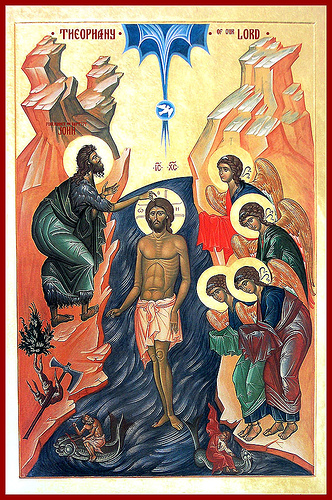
Today is a day of beginnings. It’s the first Sunday of 2018. It’s the first Sunday after the Epiphany. It’s the first Sunday you get to deal with a new seminarian. But of course, we have been dealing with beginnings for a couple of weeks now. Two weeks ago today, we heard the story from Luke’s gospel of Jesus’ birth in Bethlehem. Last week in John’s gospel, we heard that Jesus is the incarnation of the Word of God, who has been with God forever, the Word that God spoke in creation, enfleshed for us, fully God yet fully human.
But Mark’s gospel begins differently. We do not begin in Bethlehem, as we do in Matthew or Luke, nor do we begin before time and creation, as in John. Instead, we begin with John the Baptizer and the baptism of Jesus in the Jordan River. We are barely a few verses into the gospel according to St. Mark. John proclaims a baptism of repentance, promising that one who is more powerful is coming after him, a Messiah who will baptize with the Holy Spirit. And suddenly, almost nonchalantly, Jesus is there, in the water, being baptized. But as he is coming out of the water, something miraculous happens. Reality is ruptured, the normal order and pace of things are upended, and the Divine breaks into the world powerfully. The heavens are torn apart. The Holy Spirit alights on Jesus, as softly as a dove landing. And God the Father speaks, “You are my Son, the Beloved; with you I am well pleased.” And just like that, as quickly as a blink of the eyes, in the course of our routine lives, God reveals what has always been there, just beyond our understanding, just out of our sight. God reveals God’s Self to us: God the Father speaking, God the Son in our humanity, God the Holy Spirit descending.
What an incredible thing. This is Jesus’ first act of public ministry in Mark: he steps into the muddy waters of the Jordan River and is baptized by John. And this is a symbol for all of Jesus’ ministry, from his birth until his death. Jesus chooses to get into the dirty water with us. Jesus chooses to be fully like us, to take on our human nature completely. God chooses to come to us, not to remain aloof from us, but to share in our life with us.
Many of us were baptized with beautiful fonts, by priests or bishops vested in fine clothes. Some of you may have the shell that might have been used to baptize you. There was likely beautiful music. Perhaps there were Easter lilies around the font. All very dignified and right and good. But let me tell you about a friend who had a different experience. Tessa did not grow up in the Episcopal Church. She grew up in a little country church with no more than 25 people on a given Sunday. There wasn’t a pipe organ; instead, there were tambourines, accordions, and enthusiastic singing. When she was baptized at 12 years old, there were no Easter lilies or flowers of any kind. They went out into a garage connected to the church. It was in the dead of winter, cold. And there was a horse trough. She was baptized in a horse trough.
Tessa was baptized there, in the Name of the Father, and of the Son, and of the Holy Spirit. And just like all of the baptisms I have witnessed in beautiful, warm Episcopal churches, her baptism was dignified and right and good. But I must confess, there is something in me that likes the humility of the horse trough setup. There’s no facade there. There’s nothing there to cover up who we are before God. There is something there very much like Jesus stepping into the muddy, unassuming waters of the Jordan River.
What makes a baptism a baptism is not the fancy clothes we wear, or the flowers, or the little shell, or even the horse trough or the accordion-tamborine duet in the background, it is the Spirit of God, descending on us like a dove, and the heavens being torn apart as God speaks, this is my daughter, this is my son. Reality is ruptured; the normal order and pace of life are upended; the Divine breaks through into our lives. And God reveals what has always been there: We are loved by God, not a remote, faroff God, but a God that is closer than our very breath, closer than our own heartbeat.
I met a man on an airplane once when I lived in northwest Arkansas. He was probably around 60 or so, and he was in charge of plants for Wal-Mart. All of the plants for all of the Wal-Marts in the United States. He would travel around, meet farmers, and decide which plants to sell where, which vendors to use, and negotiate prices. I have never met anyone more passionate about plants. He was headed out to some farm in Georgia to talk to someone about some new strand of zucchini. He asked me what I did, and I told him I was a student, and that I was heading to seminary the following semester. Surprisingly, his eyes lit up. “I was baptized two years ago,” he said. “I spent 50-some years never knowing God–or even myself.” “Oh,” I replied, “What do you mean?” He beamed. “I just never felt at home,” he said. “I never felt I was good enough or that I had done enough. Now, I know God loves me; I can feel it.”
He went on: “Growing up, I never knew why I liked plants. No one in my family even had a garden, but I had a green thumb. Now I know why. I helped my church start a community garden to help the poor last year. We gave vegetables to 500 families. I’m starting to help other churches do the same thing.”
That man’s baptism was the beginning of a new life. It was the beginning of his ministry, just like Jesus’ baptism. That man on the airplane had discovered that we cannot fully see ourselves until we see ourselves as God sees us–as beloved children baptized into the death and resurrection of Jesus Christ. And then it all clicked: he understood why he had always had such a passion and talent for gardening. It clicks for us, too. Like that man, in our baptisms, we throw ourselves on Jesus Christ, and to our surprise, we find he has always been there beside us, right there in the middle of the muddy water of our lives.
So, today, we celebrate Jesus’ baptism, and our own. We celebrate endings and beginnings. Because baptism is an ending. It is the ending of an old life. In baptism we die into Christ’s death; we are buried with him. We die to sin. We die to living to ourselves and for ourselves. We renounce the evil powers of the cosmos, the systemic powers of injustice and oppression, and our own personal sin. We acknowledge that we can’t do this on our own; we need help. We need God, and we need the Church.
But when we die, we are also raised. We are raised into the life of Christ, into the very life of God. We are invited to be living members of Christ’s body and heirs of God’s eternal kingdom. Our human nature, the human nature Jesus Christ took on, is healed and restored. We are adopted as beloved children of God. So baptism is a beginning, too. A glorious, miraculous beginning of the rest of our life with God.

 Storied Grace