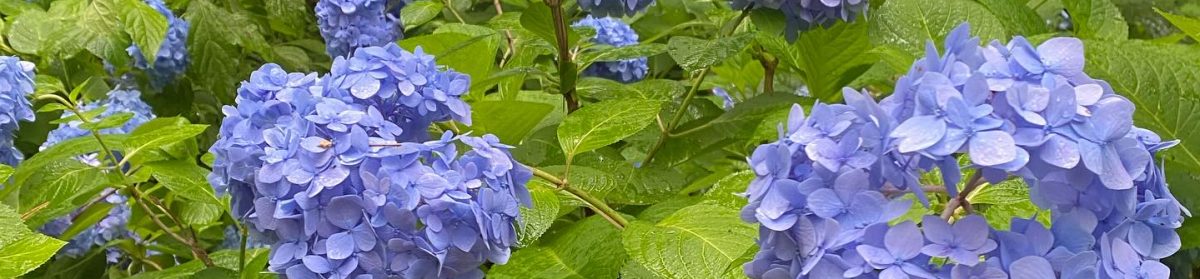
A sermon for the Sixth Sunday after Epiphany
February 16, 2025, at St. Luke’s Episcopal Church, Hot Springs, AR
Readings: Jeremiah 17:5-10; Psalm 1
Over and over, Holy Scripture compares us to trees. I know you’re flattered. We heard two such references today. In our reading from Jeremiah, the person who trusts in God is like a tree by streams of water. So, too, in the psalm. The righteous person, the psalmist says, is like that tree, connected to live-giving waters, that bears fruit and with leaves that do not wither. Both readings present us with another option, though. In each, the person who does not trust in God but tries to save themselves, the person who seeks to do evil, the person who takes the world into their hands–that person is like a dried-out shrub, like chaff which the wind blows away.
Coincidentally, our diocesan convention this past weekend had a connected theme: “Nurturing Fertile Soil.” The seeds of hope have been planted within our lives by none other than God. But in order for that plant to thrive, the soil must be right, nurtured and fertile.
Diocesan Convention used a verse from Ezekiel 17. In that passage, the prophet says that God will take a sprig and plant it in good soil. The sapling, by streams of water, will grow into a tree; it will bear fruit; it will offer shelter and protection; it will be a source of blessing for all who pass by. That tree, the prophet says, is a picture of God’s desire for Israel, the nation in exile in Babylon. Though they have been suffering under hardship, though they have felt more like a dried-out shrub, though their days of hope are long gone, they will be planted again, and they will flourish. Thereby, they will be able to fulfill their true purpose, once spoken to their ancestor Abraham: to be a source of blessing for all, no matter who they are or where they come from.
The same must be said for the Church. We are a people, called by God, to be a blessing to all, no matter who they are or where they come from. God promises that we will be restored. God promises that we will be planted in good soil by streams of water; that we will bear fruit in due season; that we will be a source of blessing for all. That’s why the Church exists: to bear the blessing of God into the world. Or, to borrow words from Archbishop William Temple: The church exists for the benefit of its non-members.
But sometimes, if I’m honest, I feel more like a dried-out bush. Sometimes I am without hope. Sometimes I cannot see a future and give into despair. If you sometimes feel like that, too, know you’re in good company. When we’re feeling dried out, it is a sign we are not connected to streams of water. We are not connected to the source of blessing. Instead of being tapped into the Lord of all life, we try to fix things ourselves, trusting in ourselves instead of in the One who made the heavens and the earth. We leave the streams of water, the waters of baptism which claim us and make claims on us–we leave those waters far behind for the convenience of following our own way. That’s a sure fire way to get dried out. And without our connection to the waters, to the source of blessing, we absolutely cannot bear good fruit; we absolutely cannot fulfill our purpose to be a blessing in the world. Friends, we must stay tapped into the waters flowing into our midst from the very throne of God; the waters that bring power to the Sacraments of the Church; the waters that inspire our hearing of God’s word; the waters that give us grace to see Jesus Christ in the face of our neighbor. We must stay tapped into the waters of baptism, into the grace, and goodness, and hope, and peace, and joy, and love of God. And then we share all of that with the world in proportion to what we have received.
Sometimes I think about a little tree I once planted in Stuttgart. It was a redbud tree. I went to give blood one day, and they gave me a little sapling on the way out. It looked like a pencil, dried out. “What’s this?” I asked. “Oh,” said the nice receptionist. “It’s some kind of tree. You don’t have to take it if you don’t want to.” But I wanted to. After all, I had just given blood. I’m O+, nearly a universal donor, so I get lots of text messages asking me to give blood. I figured giving me a dried out twig was the least they could do. I felt like I had purchased that tree with my blood.
I took that tree home and planted it. I wasn’t sure it would take. I babied it through hard winters and brutal summers. I cared for it, watered it, fed it with nutrients, pruned it. I took care of it for three years before we moved here. That last year, it had put on its first flowers in the spring. I was one proud papa.
You’re like that tree. After all, you have been purchased with nothing less than the blood of God. You’ve been planted in the fertile soil of faith by the waters of baptism. It looks like a pew with an unassuming prayer book and hymnal, a collection of prayers and daily readings from Scripture. It looks like bread and wine that possess the source of life, the Body and Blood of Christ. It looks like being reoriented to seeing the face of Jesus Christ in every one we meet, no matter who they are or where they come from, and then having the grace to serve them just as we have been served.
Christ waters us; he babies us. Sometimes he prunes us to make sure we’re growing right. He gets the weeds out of the way so the flowers and fruit can come–faith, hope, love. And the chaff of envy, pride, strife is tossed to the wind. Christ does it all so we can grow and have life, so we can be a blessing, a place of shelter, of hope, of nourishment in a broken, and despairing, and starved world. And what’s even better, he has planted us beside each other.
My friends, all we need for true life is right here. Christ provides it. There may be hard winters and brutal summers. We may be pruned by trial. But Christ cares for us through it all. And we have each other. The waters of God’s grace never cease; they always give us what we need.

 Storied Grace