Sprouting Grace

When was your very reality ruptured by a small shoot of grace sprouting in your heart?  

A sermon preached at the Chapel of the Apostles in Sewanee, Tennessee, on Mark 4:26-29, the parable of the seed that grows secretly. A video of this sermon can be found here


The Kingdom of God is like a sleepy farmer, who scatters seed, and then rests until harvest time. A sleepy farmer, who after sowing the seed, takes it easy, who lets things take their natural course and grow. The farmer does not know, or seem to care, how the growth happens.

Parables are strange. This one approaches the absurd. In first-century Judea, 80-90% of the population was engaged in agricultural labor. This was hard work. Working the ground was not a passive endeavor. Nor was it productive work. Can you imagine the listeners of Jesus, the farmers in the crowd with calloused hands and skin like leather? Can you hear them scoff? If only working the land were that easy, Jesus. If only.

Maybe we can hear the absurdity better if we change the characters. What if the Kingdom of God is like an apathetic activist, who makes some pamphlets that say, “Moms Demand Action.” She distributes them, and goes on with life. Soon, she is called to Capitol Hill to help write universal background check laws.  

Absurd. We know that’s not how things happen. If only it were that easy, Jesus. If only.

Jesus is painting a picture of how God’s grace works in our lives. Somewhere along the way, God plants something and it takes root. It sprouts up. We notice it, but maybe we’re not quite sure what to make of it. So we sit on it. We wait it out until the time is right.

That sounds like the discernment process to me. Maybe it matches your experience?

I can point to the moment I noticed the sprout. I was in St. Giles’ Cathedral in Edinburgh, Scotland, receiving Holy Communion. I felt a rush as I looked down at that morsel of bread. A sprout of something pierced through the marble flooring of my heart, sending cracks through the cathedral I had built to myself, through the well-laid plans I had for my life. I did not know it at that moment, but a seed had been sown years before, a seed that had taken root and had at last sprouted, a seed that would grow into a call to the sacramental life of the Church.

When was your very reality ruptured by a small shoot of grace sprouting in your heart?  

But after that, then what? Maybe we can learn something from those scoffing farmers in the crowd. The character of the sleepy farmer is an example of hyperbole, a way Jesus can emphasize the primacy of the work of God. This is important—God always takes the initiative; grace comes first, and God gives the growth. But we should not think that Jesus is lifting up the sleepy farmer as our exemplar. We are not called to passivity and sleep. The farmers knew working the land required hard work, that it required their all.

No, we are not called to passivity. We are not called to sleep. We are called to respond to the grace of God already at work in our lives. That’s what discernment is. It’s waking up, stopping to take a good look at that small sprout, and wondering, what in the world is going on here? When did this show up? What is it? And we do this over and over and over again.

Take Heart; Get Up, because Jesus Is Calling Us

Jesus is calling us to dedicate all of our lives to God, to follow Jesus wherever the path may lead. Jesus is calling us to offer all of who we are to God, all of our selves, souls, and bodies.

A sermon preached at Thankful Memorial Episcopal Church in Chattanooga, Tennessee, on Proper 25, Year B, October 28, 2018. Readings: Job 42.1-6,10-17; Psalm 34.1-8; Hebrews 7.23-28; Mark 10.46-52. 

I tend to experience a lot of anxiety when watching suspenseful movies. I will do just about anything to get out of watching any sort of suspense-filled movie in the theaters. If I can’t get out of it, I’ll look up a detailed summary of the movie. Knowing what is about to happen reduces my anxiety. I know how everything is going to turn out, and I watch the movie with the ending in mind. I do the same things with books. When things become too suspenseful, I skip to the end of the chapter and read backwards. Because if I know how things end, I can control my anxiety.

We read the gospels in the same way, even if we don’t realize it. We already know the ending: Jesus dies but rises from the dead on the third day, and sends his apostles out to build up the Church. We know what happens.

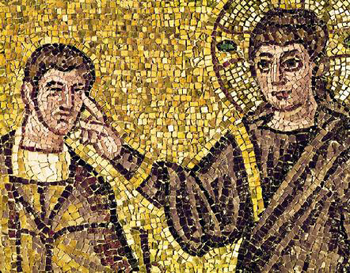
6th_Century_Mosaic_Sant_Appollinare_Nuovo_Ravenna_sm
A 6th century mosaic in Sant’ Appollinare Nuovo, Ravenna

Because we read the gospels with the ending in mind, we can overlook how important today’s reading is. It just looks like another healing story. But this isn’t just another healing; today’s gospel is a hingepoint in the gospel. It’s part of the turn that takes us to Calvary and the tomb.

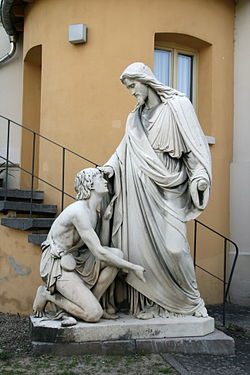
Jesus is on his way to Jerusalem. He passes by Jericho, and a blind beggar named Bartimaeus cries out to him to have mercy on him. “Jesus, Son of David,” he cries, “have mercy on me!” When the crowd tries to silence him, he cries even louder. Because of his persistence, he catches the attention of Jesus, who calls for him. Suddenly the crowd’s attitude changes. Instead of trying to silence him, they help him to Jesus. “Take heart,” they say. “Get up, Jesus is calling you.” So Bartimaeus jumps up. He asks Jesus for his sight. His sight is restored, and he follows Jesus on the way as a disciple.

250px-Christus_Bartimaeus_Johann_Heinrich_Stoever_Erbach_Rheingau
A sculpture by Johann Heinrich Stoever (1861)

Because we know the ending of the story, we can overlook that this is the first time Jesus is proclaimed as the messiah in public. A couple of chapters earlier in the gospel, Peter had confessed that Jesus is the Messiah, but that was in private with only the disciples gathered around. This is the first time in public that Jesus is identified as the Messiah. And in just a few verses, the crowds in Jerusalem will pick up on Bartimaeus’s cries as Jesus enters on a donkey. The crowds will lay down their cloaks and palm branches and cry out, “Hosanna! Blessed is the one who comes in the name of the Lord!”

So Bartimaeus, this blind beggar from Jericho who would be so easy to overlook, turns out to be a crucial person in this good news. This blind man is the first one to see Jesus. And having been healed, he follows Jesus on the way. He becomes a disciple of this One he calls the Son of David. He would follow Jesus from Jericho to Jerusalem, and from Jerusalem to the Mount of Olives. He would follow from the Mount of Olives to a place called Gethsemane. He would follow to the cross and death. From death to the tomb. From the tomb to resurrection.

Bartimaeus could not have known where following Jesus would take him. The crowds told him today, “Take heart; get up, he is calling you,” but Bartimaeus could not have known where he was going, where those first few steps would take him in the end. There was no way he could flip to the end of the chapter or read the summary in advance. He just had to follow.

We can’t flip to the end of our chapters, either. There’s no way we can know where Jesus will take us anymore than Bartimaeus could. We just have to take heart, get up, and respond to the call of Jesus to us. We just have to follow Jesus on the way, not knowing how things will turn out, but all the while trusting that Jesus is always with us, leading us along the way.   

This means that we have to give up control. We have to put our lives in the hands of God, not in our own hands. And if we take this call seriously, that can be an unsettling thing. Perhaps that’s why the crowds first tell Bartimaeus to “take heart.” It can also mean “courage”–courage to walk even when we cannot see, even when we are blind to what lies ahead, because we know Jesus has called and is waiting for us.

This is what a life of discipleship looks like. Jesus is calling us to nothing less than this: a life of complete trust in God, an open-ended commitment with no strings attached. Because that is what God in Christ has done for us: an open-ended, no-strings-attached commitment to you and me. That’s what God’s grace is.

So take heart; have courage; get up, because Jesus is calling us. Jesus is calling us to dedicate all of our lives to God, to follow Jesus wherever the path may lead. Jesus is calling us to offer all of who we are to God, all of our selves, souls, and bodies.

Take heart; have courage; get up, because Jesus is calling us.

Our stewardship season ends next week. As we approach our time to make our commitments for next year, we need to remember that stewardship is about so much more than the money we give to continue the important ministry of this place. It’s also about how we participate in our common ministry, both in this space on Sunday and out in our community the rest of the week. It’s about offering our whole lives to God–our talent, our time, and our treasure. In the end, it’s about making a commitment to follow wherever Jesus leads us as a community of disciples, and about proclaiming the living and loving Jesus to our community.

So take heart, my friends. Have courage. Get up, because Jesus is calling us.

Consider the Faithful who have Died

A sermon preached in the Chapel of the Apostles’ in Sewanee, Tennessee, for morning prayer on All Soul’s Day, on Luke 12:13-31. You can find a video of the sermon here

We live in a culture obsessed with advancement, with “making something” of ourselves. Our language betrays that we try to recreate ourselves in a cultural image of success. Like the rich fool in our parable, we toil, and we tear down our barns to build bigger barns. And that’s the best case scenario. If we fail to meet this standard—a certain amount of wealth, a higher degree of acclaim, a new level of prestige that comes with the next promotion or academic degree—when we fail to meet this cultural standard, we become anxious and worried. We strive and toil and work ourselves to death.

What do we make of these words from Jesus today, then? Could a more timely word be spoken to a culture that defines the intrinsic value and worth of people by what they can buy and how productive they are and how many vacation days go unused at the end of the year and how substantial their portfolio is? Jesus is calling us out here. He is telling us to seek a different way, to seek the Kingdom of God instead of the idols of the world.

Consider the lilies, how they grow, Jesus says. They do not work themselves to death, and yet, see how beautiful they are by just being. Look at how they are clothed with the glory of God. See how it shines through them. They are a vision of God’s love for God’s very Self, a portrait of praise to the Creator.

But can I stand before God like one of those lilies, with nothing in hand, with only myself as an offering? Can I leave those things for which I toil so much behind? Like the lilies, can I be content to be clothed with the glory of God, or must I cover it with clothes of my own making, with my own successes, with my own glory?

Today we consider those faithful ones who have died in Christ. Having commended them to God, we remember and pray for these faithful, the ones we love but see no longer, those who have gone before and whom, we trust by the mercies of God, we will see again. They have continued on, growing in more perfect service and being transformed in the light and love of God. They stand before God with nothing, and yet see how beautiful they are. They shine with God’s splendor, and their alleluias echo through the caverns of eternity. Yes, consider the faithful who have died, and do not worry, or toil, or strive. For like them, like the lilies and all of creation, we are meant to be clothed with the very glory of God.

The Rich Man and the Priest

A sermon preached in the Chapel of the Apostles’ in Sewanee, Tennessee, on October 22, 2018, Monday in Proper 24. It’s a retelling of the Parable of the Rich Fool in Luke 12:13-21. 

You can find a video of this sermon here. 


There once was a rich man who did everything his priest asked of him.

When the man was young, he started a small business, and with time, he had some success. He hired workers and his company expanded.

One day the rich man got a call from his banker. There were some interested investors, but he would have to expand more. So the man got a new building with new technology, and he hired many more workers, but only part-time. You see, when someone only works 30 hours a week, you don’t have to pay for their health insurance.

Soon thereafter, the rich man got a call from his priest. The man still felt guilty about having workers without health insurance, so he asked the priest about it. The priest said that it must be hard to run a small business with healthcare costs skyrocketing. What could you do? The topic turned to stewardship. The priest wondered if the man had ever considered pledging? The priest explained there were some significant tax benefits for someone like him. So the man pledged for the first time. For the rest of his life, he never forgot to pay his monthly pledge.

A few years later, the rich man got a call from his attorney. The state house would be considering a measure to raise the minimum wage progressively over the next five years, from $8/hr to $15/hr. Since his average front line worker made between 9 and $10/hr, he might want to make some calls and threaten to pull some campaign donations. So that’s what the rich man did.

The next day, his priest stopped by for a visit at his office. The rich man told the priest about the proposal, and asked the priest what he thought about this issue. “Look,” the priest said, “It’s hard to run a small business. We are just grateful you hire so many people in this town and pay them more than the minimum wage.” Then the priest told him they were starting a capital campaign to add on to the building. The rich man said he would give the money for the new Christian education wing, and the priest said they would name it after him.  

Many years later, the rich man got a call from his senator. Some environmental regulations were on the table, and the senator wanted the man’s thoughts. Deregulate, deregulate, deregulate. The fewer legal barriers, the more money he could make. So the environment was deregulated, and business processes were “streamlined,” and his company expanded.

The priest and the rich man met on the golf course soon thereafter. The rich man asked his priest about the environment, and they seemed to agree. They were both worried about the environment, rising sea levels and temperatures, and the uptick of once-in-a-century natural disasters. But what could one person do? Then the priest asked him if he had ever considered putting the church into his will. The man told the priest not to worry; he would leave the parish with a sizable endowment.   

Then the rich man died.

At his funeral, the priest talked about how great a Christian this man was and how much good he had done for the community and the world. The priest bragged that the rich man always did whatever his priest asked him to do. And indeed he had.

And God looked at the priest, and said, you fool.

O God, Help

We are called to be a place where we are called to help one another, to care for one another, especially the little ones, the most vulnerable, those who are otherwise sidelined or ignored or dismissed. This is a place where God’s grace and mercy flow freely, a place of love and healing.

A sermon preached at Thankful Memorial Episcopal Church in Chattanooga, Tn for Proper 21, September 30, 2018. 

Readings: Esther 7.1-6, 9-10, 9.20-22; Psalm 124; James 5.13-20; Mark 9.38-50

psalm124.JPG

We would have been swallowed up alive. The waters would have overwhelmed us. We would have been prey for their teeth. We were entrapped, like a bird in a snare. So says our psalm for today. The psalm is pointing back to some unspecified time in Israel’s history when things were not going well. And it credits God with the nation’s salvation. The Psalm opens and closes with praises to God, confidence in God’s saving help: the LORD is on our side, and our help is in the Name of the LORD.*

What is extraordinary about this psalm and so many others is its honesty. It does not sugarcoat circumstances. It doesn’t pretend as if nothing is wrong. It’s honest. And it is bold enough to point to God as the source of salvation and deliverance.

We’ve all had times in our lives when we felt like the psalmist today. We’ve felt overwhelmed, confused, bewildered, and even fearful. We’ve gone through valleys of despair. But our eternal hope is that God will carry us through. Can we find the courage to pray with such boldness and confidence?

I was told once that the simplest prayer we can offer is, O God, help. It’s the simplest prayer we can pray, but also the most honest and direct. We all need to pray that prayer. But so often, it’s the prayer we resist the most. We like to think we can carry ourselves along and be our own saviors.

But we can’t. We can’t do this without God, and we can’t do it without our community of faith. And that’s important. We cannot follow Jesus without one another. We are knit together as one body.

In our gospel reading today, Jesus is continuing to instruct his disciples about how to follow him and be a community. This teaching began a couple of weeks ago when he said we must take up our cross and follow him, and that to save our lives we must lose it. Last week he said the greatest must be the least. He took a child in his arms and said we welcome him and God the Father when we welcome the little ones among us.

This week the rhetoric is much more intense. If you put a stumbling block in front of a little one, Jesus says, it would be better if you were cast to the bottom of the sea; if your hand or foot or eye cause you to stumble, get rid of it. This is intense and even dangerous language. 

Jesus is using hyperbole and exaggeration to emphasize his point. He intends to be outrageous and catch us off guard. It’s a strategy he uses to underscore the importance of his message. Jesus is talking about particularly harmful sins and their consequences in the community of his followers. It’s referred to as a stumbling block or stumbling. But the actual language is much stronger; in Greek the word is skandalon, close to the word scandal. Jesus is not talking about this sin as if it’s like a banana peel in the middle of the road, something we might slip on but could easily sidestep. It isn’t like a ditch we can hop over. Instead it’s like a blow to the knees that causes us to fall suddenly and violently.** It is incapacitating. It is traumatic, an experience that prevents us from going on our journey of discipleship. We are so horrified that we cannot go on with our journey of faith. It’s a scandal.***

And it’s important to note that Jesus is still talking about little ones. By this he certainly means children, those who depend on us for what they have and can give nothing in return. But he also means those who are considered little ones in the eyes of those in authority, those who can’t stand up for themselves, the vulnerable among us who are taken advantage of, the poor and needy and suffering. So Jesus is saying, if any of you attacks one of these little ones with your words or actions, it would be better for you if a great stone were tied around your neck and you were drowned in the sea. It is not difficult to think of examples of the kind of sin, the kind of scandal, Jesus was talking about. This is serious stuff with serious consequences and we must take it seriously, because Jesus is very serious about this. 

Of all places, of all communities, this must be a safe place where all are cared for, especially the little ones. Social standing means nothing here, for we serve a God who became incarnate in Jesus Christ, a poor man in an occupied land. Wealth has no currency here, for our Lord had nowhere even to lay his head. Power and strength are different here, for we serve a God whose power is shown in weakness and death on a cross.

We are called to nothing less. We are called to be a place where we help one another, care for one another, especially the little ones, the most vulnerable, those who are otherwise sidelined or ignored or dismissed. This is a place where God’s grace and mercy flow freely, a place of love and healing.

trail

Last week Molly and I went hiking in Sewanee. Part of the trail was quite steep and muddy, and we had some trouble getting down and then back up the trail again. On the way back up, we were both sliding around, trying to find our footing. Molly said something like there’s nothing to hold on to. As she said that, we each extended our hands out to each other. There was nothing to hold on to except each other.

That’s what this place is. God is here for us, wherever we find ourselves. We ask for strength and grace and forgiveness and guidance. We pray that simple prayer, O God, help. We reach out our hands and God catches us with the hands of our neighbor. 


*Carol J. Dempsey, OP, “Psalm 124: Exegetical Perspective,” in Feasting on the Word, edited by David L. Bartlett and Barbara Brown Taylor (Louisville, KY: Westminster John Knox Press), 105-109.
**Thanks to Dr. Kyle Sanders for this image.
***Sharon H. Ringe, “Mark 9:38-50: Exegetical Perspective,” in Feasting on the Word, 119.

The Bread that Endures

I was honored to be asked to officiate Morning Prayer and preach at the Monteagle Sunday School Assembly on Sunday, August 5. Molly and I so appreciate their warm hospitality. 

Readings: Exodus 16:2-4,9-15; Psalm 78:23-29; Ephesians 4:1-16; John 6:24-35

Today’s Gospel reading from John contains some very familiar words from Jesus: “I am the bread of life. Whoever comes to me will never be hungry, and whoever believes in me will never be thirsty.” Jesus’ conversation with the crowds today is on the heels of the feeding of the 5,000, where five barley loaves and two fish from a young boy were multiplied to feed everyone there. When he leaves, the crowds follow him–they seek him out. They’re following him because they’ve seen signs, wonders and miracles beyond imagining. And they want to see more. Jesus knows this, so he admonishes them to look deeper, to look past the signs and wonders, past the oohs and awws and wows, and instead to look at what the signs reveal: Jesus Christ himself.
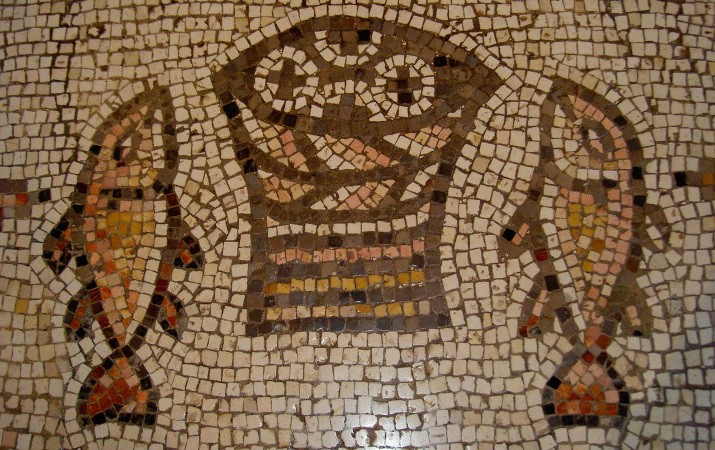
breads-and-fishes-1231752-1279x945crop-715x450.jpg

“Do not work for the food that perishes,” Jesus says, “but the food that endures for eternal life.” But they don’t seem to get it. They’re looking for another sign. They remember the manna in the wilderness, and they ask what Jesus is going to do. They just don’t seem to understand completely who Jesus is.

But this is not unusual in John’s Gospel. Throughout Jesus says and does things that confound and confuse. The crowds don’t understand–his own disciples do not understand. We understand more because we know the ending of the story; we read it in the light of the Resurrection. But not so with the people in real time; they will understand later. Jesus is just operating in a different plane. The crowds are talking about bread, but he is talking about himself. The woman at the well is talking about water, but he is talking about himself. Nicodemus is talking about going back into his mother’s womb, but Jesus is talking about being born again. They just don’t get it. They don’t get who Jesus is, that the person standing in front of them is the Son of God, fully God and fully human, who came to Earth to save the whole human race.

But maybe we shouldn’t be too hard on them. Maybe we don’t get it either? Not really. We hear Jesus say that he is the bread of life, and to work hard for the bread of life that endures forever, Jesus himself. But it turns out we like to work really hard for the bread that perishes.

We work hard for prestige. We want people to think the best of us, to only see us with our face on. We hide away certain parts of ourselves, keep them tucked well out of sight. We make sure our dirty laundry, anything that’s embarrassing, is kept out of sight when we have company. We work hard to make and preserve our public image.

We work hard for power. We like to influence. We like people to know who we are, to call on us when they have a problem or need a strong voice, to ask us to serve on their boards and help with their public events. “Call on her,” they might say. “She’s a pillar in the community.” We like that.

hamiltonIn short, we work hard to build our own kingdoms. I’m reminded of the recent Broadway musical “Hamilton.” It portrays well Alexander Hamilton’s endless pursuit of leaving a legacy, something that will outlive him and enshrine him in history. We’re not so different, are we?

We work hard for the bread that perishes, that does not endure. We get some satisfaction–after all, all of these things are good. It is good to have a good name, to influence decisions, to leave a legacy. Those are good things. But that stuff ultimately falls away; it perishes.

But today’s invitation is this: Don’t work so hard for that stuff that perishes. Work for the bread that endures forever. Come to Jesus.

That’s not an easy thing to do. Let’s not fool ourselves. It’s easy enough, I suppose to come to church on Sunday and listen to some annoying seminarian talk. Maybe the hymns are good, and we can’t miss that great potluck.

But that’s not what Jesus is talking about. Jesus is talking about reorienting our entire lives and dedicating ourselves wholly, completely, to him. Jesus is talking about a radical change. The English poet and priest George Herbert said it this way: “Seven whole days, not one in seven, I will praise thee.” Jesus is calling us to turn ourselves completely over to him, to dedicate our lives solely to him. Jesus is calling us to stop playing in the sand, to stop building our own castles, our own kingdoms.

We have been called to work for the Kingdom of God. Seven whole days, not one in seven. All of ourselves, not just part of us. Faithful to the end, not just when it’s convenient. Choose the bread that endures forever.  

assortment of baked bread on wood table

“I am the bread of life. Whoever comes to me will never be hungry, and whoever believes in me will never be thirsty.” What an invitation; what a calling. It’s a daily and persistent invitation to grace, to abundant and eternal life in Christ.

We choose to answer this calling in big moments in our lives, when we choose to make one of those life-altering and defining decisions, and chiefly in the sacraments of the Church. But we also choose to answer this calling, to respond to this invitation, in the daily, boring, normal decisions of our everyday lives, when no one is looking, when we are not even thinking about how this seemingly small choice will impact our lives later.  

Last week my wife and I helped at a choir camp in Arkansas. In addition to learning sacred music and singing for a service at the end of the week, the kids put on a Broadway review. This year’s show was about finding those small moments in our everyday lives when we can choose faith, hope, and love, when we can reach out to others with the love that God has shown us.

The final number was “Seasons of Love” from Rent. I’m sure you’ve heard the song. 525,600 minutes… the song asks how best can we measure and mark the passage of time in our lives. The answer: In acts of love. It’s a powerful piece, in no small part because of its association with Rent. Four of the lead characters had HIV or AIDS, and the play tracks the devastating effects of the epidemic in New York City at a time when most people would rather look away in fear.
rent

We choose Jesus Christ when we choose not to look away, when we choose love instead of fear, when we embrace the other, especially those unlike us. That’s when we choose the bread that endures forever. It’s in the small, everyday moments. Rowan Williams said it this way: “Our faith … depends on the possibility of meeting Christ in any and every place, and in any and every person. The degree to which we fail to find him, see or hear him, in anyone, is the degree to which we have not grasped–or rather yield to, been grasped by–his Lordship.”*

When Jesus Christ is our Lord, we can serve and love our neighbor completely and freely. When Jesus Christ is our life, we can die to ourselves, because we know we will live forever with him.When Jesus Christ is our bread, we can give ourselves away.

Today is your last Sunday together as a summer community. You are going back to your respective communities. Why not take up the challenge this year? Choose the bread that endures forever. In those everyday moments, in encounters with other people, especially those unlike us, choose Jesus Christ. Choose to see him shining in their lives. Look for him, and don’t stop looking until you find him; he’ll show up. Choose Jesus everyday, because he has chosen us, you and me, day after day after day, for all eternity.


*Rowan Williams, The Truce of God (London: Collins/Fount, 1983), 33.

Superheroes are Frauds

A sermon given at St. Thomas’ Episcopal Church in Springdale, Arkansas, on July 22, 2018. St. Thomas’ is the parish that sent me to seminary. It is always so good to be with them. 

Proper 11, Year B
Readings:  II Samuel 7:1-14a; Psalm 23; Ephesians 2:11-22; Mark 6:30-34, 53-56

“S doesn’t stand for ‘Super.’” My wife Molly explained this to me one night recently as we were watching a movie. Molly continued: “S doesn’t stand for ‘Super.’ It’s a symbol from his home planet meaning ‘Hope.’” Well, whatever it means, there’s no denying he is super. That’s why he’s many people’s favorite superhero. “Faster than a speeding bullet, more powerful than a locomotive, able to leap tall buildings in a single bound”–that’s our guy, our hero. Seemingly undefeatable with a high sense of morality, standing up for ordinary people like me, and insusceptible to the things that can get me down like the flu and machine gun fire. Superman. That’s the hero for me. 

Superman_Action_976_Gary_FrankAll of our superheroes, whether because they’re from a different planet or world, are super wealthy and geniuses, or were bitten by a spider–all of our superheroes are superheroes because they have some sort of extraordinary power, something that makes them different from you and me, that makes them more than human. They don’t have to worry about normal stuff like the flu; they can tackle the big problems of evil. Their narratives try to convince us that they, and they alone, can be our messiahs, our saviors, our hope.

Because of that, today’s reading from the Gospel according to Mark can catch some of us off guard. It can be surprising, even if it is so ordinary. Jesus tells his disciples that they all need to take a break. “Come away to a deserted place all by yourselves and rest a while,” Jesus says. They’ve been busy, to the point of not having time to eat. From the beginning of Mark’s Gospel (and we are only six chapters in at this point), Jesus has been going at a breakneck speed. He’s baptized, driven off into the wilderness, calls his disciples, launches his ministry, heals and teaches and preaches and debates with religious authorities. He calms a storm. He commissions his disciples and sends them out ahead of him to preach in other towns. He preaches in his hometown synagogue and is rejected. He feeds the 5,000 and walks on the water. Jesus has been busy.

So he gives the invitation: Come away and rest a while. You’ve been running ragged. Take a load off. Of course, as we read today, they couldn’t rest, not at that moment. They were met with multitudes everywhere they went, and Jesus had to stop to heal and teach.

But this can be alarming to some because of how ordinary it is. Jesus has to rest. It’s a reminder of his humanity–that while he is fully God, he is also fully human. And with his humanity come certain limitations. He has to rest. Rest is a good and holy and necessary thing for all of us, even our Lord.

Not for Superman, though–not really. He doesn’t need his rest. He’s better than we are.

But here’s Jesus, and he needs a nap. Just like me.

showimg_art155_fullWe like our superheroes to come with fancy outfits and superhuman abilities. We like them to come with a buffer against all that ails us mere mortals. We like them to tackle the problems we can’t, the evil in the world. They give us hope.


God could have sent a Superman. God could have sent a conquering, undefeatable military hero. God could have blinked and made a new world. But that wasn’t the plan.

The plan was to send the Son of God, the Word, Jesus Christ, as a baby who would grow up to be a poor traveling teacher without a place to lay his head, who would be susceptible to things like the flu and the cross and death. Not a super-man, but someone who is fully God and fully man.

And in him, in him alone, is hope. The incorruptible superheroes we like to lift up are frauds. Despite the S on his chest, there is no hope in the likes of Superman, or any of those Super-People we lift up as our heroes.

In Jesus Christ is the hope of the world.

The author of the letter to the Ephesians tackles the question of how we are saved through Christ. In our reading today, the author writes that “in Christ Jesus you who once were far off have been brought near by the blood of Christ.” The writer is discussing the conflict in the early Church between Jewish believers in Jesus and non-Jewish believers in Jesus. The biggest question in the early Church was what to do about non-Jews. Did believers in Jesus–all originally Jews–have to follow the Jewish law? Did they need to be circumcised, follow the dietary restrictions, and observe Jewish festivals? If they did, then non-Jewish followers of Jesus had a few more requirements before they could be accepted fully into the community of believers. If not, then we are saying that belief in Jesus Christ is enough, and while those other things might be good and even important for Jewish followers of Christ, they are not necessary for non-Jewish followers.

The writer is arguing that through Christ these two competing groups–Jews and non-Jews–are reconciled, or brought together, to God and to one another. The dividing wall that has separated them has been broken down. Why? Because through Christ and through Christ alone, we all have access to God: Through Christ we all have access in one Spirit to the Father. And because of that we are all members of the household of God, with Christ as the chief cornerstone.

But we need to notice: It is through the blood of Christ, through his death, that we are reconciled with God and with one another. It is through the humanness of Christ–the very thing that our superheroes try to reject–that we are saved. All of this is only possible because of the humanity of Christ, because he was willing to die, just like each one of us will die. Because of all of that, he is our only hope, he is the source of our unity, he is our Savior. Through him we get to God, and we become part of the very family of God, with prophets and saints of ages past. Through his death and resurrection, evil and death are really defeated, and we really have life.   

You know, our grownup superheroes look a little different than they did in the comic books or on TV. Our superheroes don’t wear capes anymore; they look more like Clark Kent than Superman. They don’t have laser vision; they usually have impressive resumes and even more impressive bank accounts. They don’t have an “S” across their chests; but they have fancy titles and prestigious positions. Sometimes they have an “R” or a “D” after their name. But their message is the same: Put your hope in me. Trust me to solve your problems. I’m invincible and all powerful. Let me save you; let me be your Messiah.

infant-superman-costume

Perhaps even more often we hold ourselves up to this superhero standard. We exalt ourselves, expect us to solve our own problems, to be our only hope. We try to convince the world that we can rise above ordinary, human problems. We walk around with smiles painted on our faces, afraid someone might catch a glimpse of the crack in our defenses. We are terrified that someone might see that we are not faster than a speeding bullet, not more powerful than a locomotive, and most days, we cannot even jump over a casual hurdle.

We cannot be our own Messiahs. Those outside voices cannot be our Messiahs. But the good news is that’s not the Christian hope. 

For our hope is in a God who came as a human, to live and die and rise again on the third day; who, yes, got tired and needed a nap. It’s disarming–and even a little alarming–that Almighty God would come in such an unexalted, normal way. But that was the plan to save us, to free us from the powers of sin and death, to defeat evil, and to make us children of the living God.

God our Mother

We are called to be bound up in God, to live in God’s love, to base our decisions and go about our lives with a different world in mind. We are not of this world, with its limits and shortcomings and failings. And thank goodness. We are of God. We belong to God. We live in God.

A sermon preached at Thankful Memorial Episcopal Church, Chattanooga, Tennessee, on the 7th Sunday of Easter, Year B, and Mother’s Day.
Readings: Acts 1:15-17, 21-26; Psalm 1; I John 5:9-13; John 17:6-9

In today’s Gospel reading, Jesus is saying goodbye to his disciples. He is praying that God will give his disciples–and us–strength to be witnesses of Jesus Christ. And it does take strength. Jesus’s prayer says that just as he was in the world but not of the world, so, too, are we in the world but not of the world. We are separate from the world somehow, even if we live in it, because we are united to God through Christ.

“They do not belong to the world,” Jesus prays, “just as I do not belong to the world” (Jn 17.14). It is easy to see how Jesus did not belong to the world. In the beginning of John’s gospel, we read that Jesus “was in the world, and the world came into being through him; yet the world did not know him” (Jn 1.10). Throughout his life, he moves in a different plane. As fully human, he lived like us, with both suffering and joy. But he was also fully God. And that means Jesus’s relationship to God the Father was a little different from ours. Their relationship was so close, so intimate and personal and connected. And people picked up on this. People could see that Jesus did not belong to the world. He belonged to God, and God alone.

Jesus is calling us to this. We are called to this relationship with God, through Christ. We are called to belong fully to God; we do not belong to this world.

Growing up, my mother showed me what it is like to be connected to God in this way–or at least, as much as we can now. My mother lived in the confidence that Jesus was always just a breath away from her. As a single mom in college for much of my childhood, her confidence in God could not be theoretical. She depended on God, in a real way, for real needs.

One Sunday night, we were driving home from church. I couldn’t have been older than seven. The little church was out in the country, and we had to take a winding state highway back to the town where we lived. That particular night, we rounded a corner, and there was a deer. I’m sure it’s an experience most of us have had. Mom slammed on the brakes, but it was too late. As the deer crushed the front of the car and hit the windshield, the only thing I remember is Mom saying, Jesus. I suppose there were a lot of things she could have said. But her instinct was to pray the shortest prayer she could spit out in that split second. Her first line of defense was to breathe the name Jesus.

Mom sings all the time, sometimes without knowing it. One of her favorites is “What a Friend We Have in Jesus.” It fits her. One of the lines in that hymn is that we should take “everything to God in prayer.” And she’s not bashful about this. Even today, when I say I have a problem or worry, her response is often, “Well, have you prayed about it?” And there aren’t many things she hasn’t prayed for. She prayed when we hit the deer. She once prayed over a car that couldn’t be fixed for a while, but needed to make it through a trip. And I know she prays for Molly and me. We can feel her prayers.

In a real way, Mom’s citizenship is not in this world. It is in heaven. She belongs to God, and God belongs to her. She still lives in the world: she goes shopping, she pays her bills, she works. But her eyes are toward God.

This is what God wants from us. God desires for us to be in close relationship with God, to be drawn up into the life of God. And today, this is what Jesus prays we might experience. Jesus acknowledges that his disciples, his closest friends, are not his, but are God the Father’s. They are a gift to Jesus from his Father, and just like Jesus, they belong to the Father. The same is true for us. We belong to God as God’s own beloved children.

I have heard it said that if we want to see the love of God, we should look at the love of mothers for their children. I think that’s true with me. And for many, that’s how they understand the love of God. Children belong to their mothers, forever. The children may be great or not. They may be wonderful role models or get into trouble. But they still belong to their mother.

I heard a story recently about a mother with two sons. One son was the valedictorian of his class, went to college, had an internship at NASA, and went on to a successful career and to have a family of his own. His mother loved him very much. But the other son had some troubles. He had a problem with addiction, even at times stealing money from his mother to support his habit. His mother loved him very much, too. When the older brother asked her about it, she said that she had no illusions about the challenges her youngest son faced. She could see plainly the damage he was doing to himself and others, including her. But she loved him. And she always would. And he would always have a place at her table.

So maybe it’s true much of the time: If you want to see the love of God, look to the love of a mother. But sometimes people are hurt by their mothers, whether by absence or neglect or abuse. I once met a young woman in the emergency room when I was working as a hospital chaplain. Her name was Paige. She was there with her mom, who was dying. When I asked how she was doing, she said she didn’t know what to feel. Her childhood had not been a good one. She was neglected by her mother, and eventually abandoned. She had only reconnected in the last few weeks as her mother’s condition worsened. This young woman, now a mother of two of her own, looked over at me, with tears running down her cheeks. She said, “You know, the worst of it is, I was so scared of being a mother. I was afraid I would not be able to take care of my kids, like my mom. I’m still scared.”

So I asked, “What made you change your mind, Paige?”

“I became a Christian. And I learned how to be a mother from God.”

She learned what love looked like from God. She learned what acceptance looked like from God. She learned what forgiveness looked like from God. She learned what motherhood looked like from God. She learned that she had the strength and courage to love as a mother, because God loves her. And God, the mother of us all, loves us, too. Fiercely.

I think this is part of what it means not to be of this world. In this world, love has conditions. Belonging has its limits. We experience our own shortcomings and the shortcomings of other fallen human beings. But not so with God. We belong to God, forever and always. The love of God is boundless.

That is the world we are called to live in. We are called to be bound up in God, to live in God’s love, to base our decisions and go about our lives with a different world in mind. We are not of this world, with its limits and shortcomings and failings. And thank goodness. We are of God. We belong to God. We live in God.

We are in this world, but we are not of this world. And because of that, we can love with an otherworldly love. We can dare to love with the very love of God.

Jesus Christ and Mayberry

Christ calls us to Christian community, where we who are many and different are one body, because we all share one bread and one cup. This is real, authentic community, stripped of illusions, where we are not united because we are all the same, but because we all belong to Christ.

A sermon preached at Thankful Memorial Episcopal Church in Chattanooga, Tennessee, on April 15, 2018, Easter 3, Year B. 

Readings: Acts 3.12-19; Psalm 4; I John 3.1-7; Luke 24.36b-48

One of our biggest temptations during times of uncertainty and transition is to long for those good ole’ days–the unspecified times in the past when in hindsight, everything seemed right and good and like it should be. The country artist Rascal Flatts says it this way: “I miss Mayberry, sitting on the front porch drinking ice cold cherry coke, where everything is black and white.” Whatever our own personal Mayberry might be, we miss it. Those were the good ole’ days of yesteryear. But, ultimately, Mayberry is a temptation because it is an illusion, and an illusion that can become an idol. Those good ole’ times we idealize had their own rough patches. Maybe we don’t remember them so well now, but they were there.

Mayberry

The Church is subject to the same temptation. We miss the good ole’ days when… When everyone was off work on Good Friday; when there weren’t baseball games or Ironman triathlons on Sunday; when we didn’t disagree on this or that; when every family looked like a Norman Rockwell painting.

The first letter of John, which we heard from this morning, shows us that there was never this golden time in the Church when everything was perfect. Our reading today has this lovely verse in it: “See what love the Father has given us, that we should be called children of God; and that is what we are.” How perfect. It is tempting to hear that and smile and claim we are all one family, each one of us a child of God, all united in our love for God and for one another. Just like in Mayberry, sitting on the front porch swing, ice cold cherry coke in hand, loving Jesus and loving each other, without a care in the world.

But, if we’re honest, that’s not reality–not for us, and not for the community of I John.  No, the community to which this letter is addressed is a community in turmoil, in the process of dissolution. It had fractured in two. From the rest of the letter, scholars think that the opponents of the writer of I John claimed to be sinless and perfect themselves, that Jesus’ humanity was not important for salvation, and that they didn’t have to follow the commandments, including Jesus’ new commandment to love one another. The writer of 1 John tries to argue against all these heresies.  And naturally, both groups claimed to be speaking by the power of the Holy Spirit.*

These are serious disputes. They’re not arguing about small things, but about the foundation of who they are, only 70 or so years after the death and resurrection of Christ. The stakes are high. People are upset. We’re not in Mayberry anymore.

We read this section of I John during Eastertide, so we get this picture of turmoil and conflict in Christian community alongside the resurrection appearances of Jesus, alongside the surprise and wonder and excitement of discovering that Christ is risen! We get this communal friction alongside our alleluias. But that’s the whole point of Easter, really, because that does reflect our lived reality as Christians in community.   Over and over again, right in the middle of our hopelessness and conflict and turmoil, the resurrected Christ shows up.

In today’s reading from the Gospel according to Luke, the disciples are in a room in Jerusalem. They have been met by a couple of folks who were on their way to a town called Emmaus. They met a man on the road who talked with them about Jesus and his death. And then at table, this man took bread, broke it, and gave it, and their eyes were opened. And the man was Jesus Christ. They run back to Jerusalem to tell the others. And while they are telling them, Jesus shows up.

They are startled and terrified. Jesus says, “Peace be with you.” He shows them his hands and his feet. He commissions them as witnesses to his life, death, and resurrection. They are sent to proclaim the good news.

duccio_locked_doors1
The Resurrected Christ appears in the room with his disciples.

Jesus chooses to show up, to reveal himself to his disciples, when they are wondering what the future holds. Jesus chooses to show up when they are terrified and on edge. The resurrected Christ shows up, not when things are perfect and calm, but when they need him most–in their anxiety, questioning, and despair. And Christ makes them a community again–a community of witnesses to the good news of God in Christ.

Christ shows up here, too. Christ shows up in our lives today. The resurrected Christ shows up in the midst of our turmoil and uncertainty. And Christ makes us, like those first disciples, witnesses to the good news of God in Christ Jesus: that the love of God is stronger than death itself, and that God loves us–even us–with such powerful love.  

Christ does not call us to Mayberry, where differences are ironed over and ignored, this imagined community of what-ifs. Christ calls us to Christian community, where we who are many and different are one body, because we all share one bread and one cup. This is real, authentic community, stripped of illusions, where we are not united because we are all the same, but because we all belong to Christ.

Christ calls us to be a resurrection community, where God’s love is not only abundant in these walls, but where God’s love spills out of us and we become bold witnesses to what God has done in Christ.  

But for this to happen, we must leave Mayberry behind. The what-if, imagined, idealized Mayberry communities only distract us from what Christ is calling us to now. These Mayberrys keep us planted in the past, in the world created in our image and in our likeness. They are a prison; they are blinders on our eyes; they are stumbling blocks on the way. But the resurrected Christ calls us to the now. We are called to be his witnesses now. We are called to see a world created in the image and likeness of God. We are called not to Mayberry, but to the Kingdom of God and to live a resurrection life in Christ.


*See, e.g., Raymond E. Brown, The Community of the Beloved Disciple: The Life, Loves and Hates of an Individual Church in New Testament Times (Mahwah, N.J.: Paulist Press, 1979).

We Have No King but Christ

Or we can follow Jesus on the way of the cross. Jesus Christ can be our king. We can put our ultimate trust and loyalty in him.

agnus
The Lamb of God that takest away the sins of the world. A stained glass window at my sending parish, St. Thomas’ Episcopal Church in Springdale, Arkansas.

Thankful Memorial Episcopal Church
Chattanooga, Tennessee

Good Friday

Readings: Isaiah 52:13-53:12; Psalm 22; Hebrews 4:14-16, 5:7-9; John 18:1-19:42

The Gospel today provokes the question, who is our king? We have two choices: the emperor or Jesus. Which king will we follow? In whom will we place our trust?

The crowds at Pilate’s headquarters give us their answer: “We have no king but the emperor,” they cry. Jesus, this King of the Jews, is not their king. Their loyalty lies with Rome.

Pilate’s king is certainly the emperor. Pilate’s power is dependent on his relationship with the emperor–he only serves at the emperor’s pleasure. If Pilate wants to hold on to power (and he does), he must stay on the emperor’s good side. Send the taxes to Rome; maintain order no matter what. Pilate has no king but the emperor.

The followers of Jesus are faced with the same choice in a sense. Will they follow Jesus to the cross, or will they go their own way? The women and the disciple whom Jesus loved follow Jesus all the way to the cross; others choose to abandon him and seek their own self-preservation against the threat of Rome.  

Who is our king? Ultimately this choice is a question of trust. We are asked, in whom will we put our trust? Will we place our trust in emperors? Or will we place our trust in Jesus Christ, the Son of God? Will we look to fine palaces, places of power and prestige, with thrones and symbols of authority? Or will we look to a hill on which stands Jesus’ throne, the cross?

In our daily lives, we are presented with many emperors. We are invited over and over to place our ultimate trust in a never-ending stream of things and people. We are told to put our ultimate trust in the power of money. Invest in this scheme; buy gold; hire this financial adviser; trust the market. We are told to put our trust in political figures or ideas. Follow this person; they know how to straighten everything out. If only everyone would buy into this taxation strategy, everything would be fixed. If only we all listened to this news source, we could be saved. If we carry a gun, we will always be safe. And then there’s our health: take this magic pill. Practice this form of meditative stretching. Go see this doctor or read this book. Now we can freeze our bodies and put them in storage, all in the hope that one day when they find a cure for our illness, they can revive us and heal us. All these things become the keys to our own peace and security.  

We are looking for saviors. After all, we need saviors. The world in which we live is often unstable and unpredictable. Our bodies and our pocketbooks are prone to threats. We want something to save us–something to protect us from vulnerabilities, from weakness. That’s what emperors are. They are our saviors–or those who claim to be our saviors, to have all of the answers. These are the things that claim our loyalty. Follow us, say these worldly emperors, and you will never be vulnerable.  And we are tempted to respond, like the crowds, “We have no king but [these] emperor[s].”

Or we can follow Jesus on the way of the cross. Jesus Christ can be our king. We can put our ultimate trust and loyalty in him.

The way of Jesus–the way of the cross–is not the way of these emperors. It is not a way that directs us away from vulnerability; it takes us right into it. It is not a way that shields us from weakness; it plunges us into it. It is not a way that shys away from pain; it shows us that the price of love is pain. And to our amazement, we find that this way is the way of life and peace. It is a path paved with love–not sentimental love, but true love that sacrifices and gives without seeking anything in return.

This salvation is different from what is offered by the worldly emperors. Unlike them, Christ does not claim to offer us a carefree way. Christ offers us life and freedom: a life and freedom rooted in the power of love, in the power of giving everything and holding nothing back, in the power of sacrifice, in the power of obedience to God, in the power of the cross.

On Good Friday, we look at Jesus, we look at the cross, we look at this way of love that plunges us into vulnerability, weakness, and pain, and we are called to choose that. We are called to confess that we have no king but Christ. We are called to reject the emperors of the world for what they are: false gods with empty promises. For on the cross, we see the Son of God; we see our King. We see the way of life and peace. We see our salvation and the salvation of all the world.