The Prodigal’s Lesson

A sermon preached for the Fourth Sunday in Lent
March 27, 2022

I will get up and go to my father, and I will say to him, ‘Father, I have sinned against heaven and before you; I am no longer worthy to be called your son; treat me like one of your hired hands.

These are familiar words to us, the words of the so-called prodigal son after he realizes how far he has fallen into sin. After squandering all he has been given, here he finds himself in a pig pen–a Jew in a pig pen–with no hope. But he comes to himself and realizes he can go home, even just as a servant. And he hopes beyond hope that his father will somehow find it in his heart to forgive him. 

We all know this story so well. It is one of Jesus’s best known parables, and it is all about forgiveness. About how God forgives us and never gives up on us. It’s also about how we can accept forgiveness, or grow in pride, resentment, and hatred. 

We call it the parable of the prodigal son, but that’s not what Jesus calls it. Jesus starts the parable by saying, “there was a man who had two sons.” For Jesus, this is the parable of the two sons. Which son would you rather be? The one who finds himself rehearsing his lines in the pig pen, or the one who dutifully stays home and cannot believe his father is such a pushover? No matter which son we are, the father is there, waiting for us. For like Jesus, the father in the parable, our stand-in for God, “welcomes sinners and eats with them.” That’s you and me. 

Let’s look at the parable. Out of greed, the prodigal son cashes in his inheritance early. He goes off to a distant country, outside of Israel. There he squanders everything on dissolute living. He hits rock bottom, and only then is he able to look up, to realize what he had, and he dares to go back to his father. But he does not do so with any pride or arrogance; all of that has been stripped away. He goes humbly, knowing he has messed up, simply asking to be a servant. 

He is a model of what repentance looks like. He knows he has messed up, and messed up badly. He acknowledges he has messed up, and he confesses his sin to his father. He asks for grace. He isn’t demanding his former place, for he knows he could not deserve that. He lowers himself as low as he can, and he begs for mercy. The youngest son that once was oozing pride and greed and lust and envy at the beginning of our parable has now been taken down to size. Instead of pride, greed, lust, and envy, we see humility, lowliness of heart, sincerity, meekness. He knows he is a sinner. And he prays that simple prayer: Father, have mercy on me, a sinner.  

Truthfully, most of us cannot identify with that youngest son. In fact, when I ask folks who they identify with in the parable, at least 90% of people will say the oldest son. The youngest son is just too much unlike many of us. But I bet he wasn’t unlike the people Jesus was eating with. Maybe, as they heard the story, they exchanged looks of recognition with one another. “Oh yeah, I’ve been there before.” 

We usually identify with the elder son–I always have. But I’m not so sure about that now. The elder son shows up at the end of the parable, but he’s been there all along. He saw how brazenly his younger brother took his inheritance. He would shake his head in disbelief as his father doled out the cash. Maybe he had already written off his younger brother. As the father watched the road for the return of the younger son, I wonder where the elder son was? Did he care anymore? When his brother comes back, all of this hatred comes out on his father. Jesus tells us he is so angry he even refuses to go into the party, refuses to welcome his brother back. He’s dead to him. “Listen!” he tells his father, “For all these years I have been working like a slave for you, and I have never disobeyed your command; yet you have never given me even a young goat so that I might celebrate with my friends. But when this son of yours came back, who has devoured your property with prostitutes, you killed the fatted calf for him!” Can you hear his anger, his resentment and bitterness? 

The parable ends there. No reconciliation. The older son refuses to show mercy, refuses to give grace to his brother, he cuts off the relationship. The father gives his explanation, but Jesus doesn’t tell us that the elder son admitted his wrong, asked forgiveness, and went into the party to welcome his brother home. No. Jesus just leaves us hanging. 

Maybe Jesus doesn’t have to tell us the end, because everyone in the room around him already knew it. When Jesus finished telling the group about the prodigal, we imagined that all those sinners and tax collectors in the room shared a knowing glance. “That’s me. I’ve been there before. Thank heaven I’m not there now.” In the same way, when Jesus ends the parable, I imagine there are some more knowing glances, but this time between those grumbling pharisees and scribes. “Oh, Jesus is saying we’re that elder son.” 

Is it better to be the prodigal, or the older brother? Is it better to be the one who fell so fast but asked for mercy, or the one who did what he was told but in pride, with hatred, resentment, and bitterness in his heart, refused to show mercy?  

Maybe we haven’t fallen as low as the prodigal. Maybe we have. Regardless, I hope we can all adopt his spirit of lowliness, of humility. I hope, like him, we can all recognize that we need mercy and grace, even if we don’t deserve it. I certainly hope we are not like that older brother, so full of ourselves, so puffed up with pride, that we close the door to mercy, we close the door to grace, we close the door to reconciliation and healing and wholeness and love. It’s better to be prodigal but repentant, than prideful and merciless.

The truth is, we’re all sinners in need of the Father’s mercy and grace and forgiveness. And it’s on offer. God’s got it on tap. But like the elder son, it is so easy to cut ourselves off from it. It is so easy to get puffed up in pride, to put our noses up in the air at those sinners over there, and to rely on our own work, our own righteousness, our own goodness–when the truth is our own work and righteousness and goodness do not amount to anything at all. No matter who we are, we need the Father’s mercy and forgiveness and love. And we can have it. We just have to take a lesson from the prodigal, and, in humility and sincerity, ask for it. Jesus is telling us today to be like the prodigal. 

We carry around a lot–each one of us. We carry shame from past mistakes. We carry guilt that keeps us awake at night. We carry around those what-ifs that never go away. Those old tapes of past misdeeds play in our mind on repeat. We think that what we’ve done, who we are, is somehow unforgivable–that the father will have nothing to do with us. Perhaps like that elder son, we carry around pride, too, some resentment, bitterness, and hatred. Whatever it is we carry, we beat ourselves up, never letting go of that past, never letting ourselves be forgiven or daring to forgive ourselves. And we fear–fear that there is no hope for us and we will be left alone, unloved by God our Father, unloved by Christ himself. We fear we cannot be redeemed. 

But that’s a lie. We can be redeemed. We can be forgiven. We are loved. When we dare to be like the prodigal, we ask for mercy and grace and forgiveness, and we lay all of those heavy burdens down. We don’t find a vengeful father who throws us out. We don’t find that all of our worst fears of rejection come true. We do not find that we can never be loved or forgiven. By no means. Instead, we find a Father who picks us up again, who restores us even though we do not deserve it, who gives us grace and love. Because for the father, for God, forgiveness is easy and love is who he is. We don’t have to keep beating ourselves up. We don’t have to wallow in shame and guilt. We just have to ask for forgiveness. 

You and I, we can go home. The Father is already watching and waiting for us. The arms of God are open wide, waiting to embrace you, waiting with forgiveness and love.  

Good Church People

A sermon for the Third Sunday in Lent
March 20, 2022

“Unless you repent, you will all perish as they did.” Jesus is not beating around the bush here. He’s really telling us like it is. Repent. Turn around. Turn to God. It’s the call of this penitential season. In Lent we acknowledge we don’t have it all figured out. We are sinners in need of God’s grace. Perhaps, though, I am preaching to the choir, as they say. After all, we good people are in church, where we confess our sins all the time, not just during Lent. The truth is, though, we good church people need this message desperately. 

The people Jesus is talking to today considered themselves good church people, like us; they were righteous, trying to follow God, concerned with the ways of God. They come to Jesus today and tell him about two tragedies. The first is an apparent massacre by Pilate, and we know he was a brutal ruler. So brutal, in fact, that Rome would eventually recall and remove him from his post. He went too far, even for Rome. The second is an accident where a tower fell on people. We don’t know the details of either of these events; they have been lost to the historical record. But based on Jesus’s response, we can surmise that the people coming to Jesus must have thought that those who died were somehow deserving because they were sinful. “Hey Jesus,” they must have said, “Did you hear about those Galileans that were killed, and about those people who were killed when that tower fell. They must have been sinners, huh? I’m glad we’re not like that. We’re church good people. We go to church every Sunday. We give a pledge. We volunteer. We sing the hymns and pray the prayers. Yes, we’re good church people–not like them.” 

Jesus hears what they’re saying, and then says something startling, something that must have shocked them. He warns those good church people to look out: “Unless you repent, you will all perish as they did.” He’s saying, you may be in church every Sunday; you may give a pledge; you may give your time and talent; you may sing and pray; but you’re a sinner. Repent. 

His warning is for us, too, the good church people today. If we’re not careful, we can fall into the same trap of self-righteousness. We can think, oh we’re so good and we have it all figured out. That’s exactly the moment when we push our savior out of the picture. That’s exactly the moment when we know we’re not living by God’s grace and mercy. Because the truth is, yes, we try to do right. We try to do good. We come to church. We pledge. We give of our time and talent to worthy and holy causes. We sing the hymns and say the prayers. And all of that pleases God. But we’re still sinners. And we still need Jesus. We’re not all good by ourselves; we need our savior.  

A favorite theologian of mine, Dietrich Bonhoeffer, said something along these lines. He is comparing the church–the real church with real people–to what he calls the pious community. So often, instead of encountering the real church with real people, we encounter this pious community. Said another way, instead of meeting sinners in the pews, we meet good church people who have it all figured out. Here’s what Bonhoeffer said: 

The pious community permits no one to be a sinner. We are not allowed to be sinners. Many Christians would be unimaginably horrified if a real sinner were suddenly to turn up among the pious. So we remain alone with our sin, trapped in lies and hypocrisy, for we are in fact sinners.

Dietrich Bonhoeffer in Life Together

I hope we Episcopalians on the Prairie have enough grace to fess up to who we are: we’re not good church people; we’re sinners. Sure, we try. We try to do good. We give our time, talent, and treasure. We sing the hymns and say the prayers. And we know that all of that pleases God! But we don’t have it all figured out. We can’t save ourselves. This is not a pious community, full of perfect, good church people. This is the church. And that means we are a community of sinners, and we need Jesus. We need his grace, his forgiveness, his love, his life. And if one of those sinners, out there, walks through our doors, I hope we will see them for who they are: Just like us. 

At the end of today’s gospel, Jesus tells this parable: “A man had a fig tree planted in his vineyard; and he came looking for fruit on it and found none. So he said to the gardener, ‘See here! For three years I have come looking for fruit on this fig tree, and still I find none. Cut it down! Why should it be wasting the soil?’ The Gardener replied, ‘Sir, let it alone for one more year, until I dig around it and put manure on it. If it bears fruit next year, well and good; but if not, you can cut it down.'” Often, when we think about what this parable means, we think God is the one who comes up to the tree and tells us to cut it down. You and I, the gardener, we ask for another year. We dig around to see if we can make it better. 

I want to suggest that there is a better way of seeing this parable. That little fig tree does represent us. It’s our spiritual lives. And sometimes, our spiritual lives need some work. We’re not very impressive. But it’s not God who walks up to it and says, cut it down. No, it’s those good church people. The people who have it all figured out. They come up to our spiritual life, and they say, oh this is worthless. We can’t have this kind of pitiful tree here. What would the neighborhood association say? This is a sinful tree. It’s not worth having around. We only keep good company with good church people, with respectable trees in respectable, well-manicured gardens, no weeds at all, perfectly pruned and always looking exactly right. And if this tree wants to be with us, it’s going to have to be like that. 

Maybe, in some backwards way, we are the ones who walk up to that tree, to our own spiritual lives. After all, we have heard all of this talk of what we are supposed to look like, be like. Those expectations of those good church people can become our expectations of ourselves. We can get caught up in their way of seeing, and we can begin to evaluate ourselves through the eyes of others. And we feel worthless, less-than, out of place, shameful. 

We walk up to our own little tree. We look down on our own spiritual life. We see the truth of it all, the stuff not everyone can see. We see our shame, our guilt, our missteps, our failings. We look down on our prayers, on our faithfulness. We consider all of those expectations of the good people who have it all together, or so they say. Even though we have tried so hard, we find that we come up short of those expectations. Cut it down, we say. It’s not worth it. I have worked so hard myself, and I haven’t been able to make that tree look like I want it to. This spiritual life of mine isn’t pretty enough, isn’t good enough. What’s the use? Cut it down. Give up. 

But then we hear that voice. The gardener. He’s filthy. He’s been working hard. He says, Wait! ‘Sir, Madam, let it alone for one more year, until I dig around it and put manure on it. If it bears fruit next year, well and good; but if not, you can cut it down.’ Give me some time, he says. I will do the work. I will help the struggling tree. I know what to do. 

We don’t recognize the gardener. He is almost a nuisance. We would rather just be done with it and wipe our hands clean. No, we don’t recognize the gardener. But hey, Mary Magdalene didn’t recognize him either. We don’t see that it’s Jesus. Jesus, our savior, who wants to work on us. Who wants to dig around. Who wants to help us. If only we will let him. If only we will turn to him and allow his grace, his work, to change us. 

Lent is calling us to give in to what the gardener wants to do in our lives. Lent is calling us to give up trying to do it ourselves–give up trying to be those good, perfect church people. The world has enough of those. No, Lent is calling us to confess to who we really are: we’re sinners in need of God’s grace. And God in Christ is right here. Christ the Gardener is digging around, trying to help us grow, making us healthy and fruitful. 

But we, that little tree, we have to stop fighting. We have to let the Gardener work, and stop trying to work it out ourselves. We have to let the grace in. We have to turn to the Gardener–that’s what repentance is. We admit that we don’t know how to do it on our own. We need the Gardener to work on us. We turn from our own way and turn to him. We trust that he knows what to do. And then we really start living and growing and bearing good fruit. And just maybe, we can stop looking down on that little tree. Maybe we can learn to see that little tree of our spiritual lives through the loving, gracious, and caring eyes of Christ. 

I imagine The Trinity gets together at Jesus’s place. It’s a standing meeting for coffee and cookies. The Father and the Holy Spirit ask the Son, “Well, Jesus, what’s new in your garden?” His eyes light up. He puts his hat and gloves on, grabs his shears. “Let’s go see,” he says. They walk out into a big garden. In the middle of it is a big apple tree: the tree that started it all, the tree of the knowledge of good and evil. A chunk of it is missing, just enough wood to put a cross together. Around it are other trees: the St Alban boxwood hedge, the St Peter giant oak, the St Mary Magdalene rose bush as big as a redwood. But Jesus leads them all past all those, and he takes them to a small fig tree. There’s a small stone at the base of the tree, and your name is on it. He bends down, touches the branches. He points with excitement to the smallest blossom—fruit is starting to come in. He says, “I’ve been working on this one. I think it’s the most beautiful thing in the whole garden.”

Land of Promise

A sermon for Lent 2
March 13, 2022

What do you seek? This question comes from the historic Catechumenate process in the Church. The Catechumenate was the three-year method for preparing candidates for holy baptism and confirmation. And y’all think my 6-week course is bad! As the priest is enrolling people in the program, the priest asks this very simple question: What do you seek? 

What do you seek, Abraham? Abraham, that wandering Aramean, would respond, I am seeking that land of promise, that country that God swore to show me. We first hear this promise in Genesis 12, when God calls Abram from his home in a place called Ur. 

‘Now the Lord said to Abram, “Go from your country and your kindred and your father’s house to the land that I will show you. I will make of you a great nation, and I will bless you, and make your name great, so that you will be a blessing. I will bless those who bless you, and the one who curses you I will curse; and in you all the families of the earth shall be blessed.” So Abram went, as the Lord had told him.’ (Genesis 12:1-4a) 

The rest of Abraham’s life (and his son’s life, and his grandson’s life, and countless other lives all the way through Egypt and the wilderness) would be spent seeking after that land of promise. 

But in today’s reading, Abraham is having a little doubt. Can we really blame him? Here God has promised to bring him to a new land and to make a great nation. But there’s a problem with that. Not only is Abraham an alien in a foreign land, but God has not yet given Abraham children. You have to have some of those if you hope to be a great and vast nation. So, naturally, Abraham is doubting. He’s thinking, maybe I didn’t hear God quite right? Maybe God meant something a little different than I was thinking? Or, maybe God has forgotten me? 

Have you been there? When I was visiting seminaries, I visited Virginia Theological Seminary, in Alexandria, Virginia, just outside D.C. I flew into Reagan Airport, as I had been instructed. I grabbed my luggage and I went outside. My ride was supposed to be there. No ride. He had forgotten. Sometimes our life of faith can be like that. We’re going on this journey, we’re in a new and strange place, and we can feel as if God has forgotten to pull the car around to get us. We can feel like we have been left alone, stranded. 

I saw a news story from Ukraine this week. A man and woman, in love, engaged, had planned to be married later on. They no doubt wanted to be married in one of those beautiful Ukrainian Orthodox churches, with the priest chanting, incense billowing everywhere, candles and loved ones surrounding them. Instead they got married on a battlefield. They put down their weapons for just a moment, still dressed in their camo, although the bride had donned a veil. They made vows before God. They promised everything and forever, though they knew, more than ever, that they were not guaranteed tomorrow. They asked God to watch over them. The priest blessed them and placed the cross over their joined hands. And then it was back to war. I couldn’t blame them–I don’t think any of us could blame them for lamenting, God it wasn’t supposed to be this way. We were supposed to be headed for a very different land, and we thought our lives would look much different. This battlefield isn’t what we were expecting or hoping for. Have you abandoned us? Have you forgotten us? Did we hear your call right? 

If we listen, we will hear God respond: even though your life looks different than you may have expected or hoped for, I haven’t forgotten you. Abraham hears God say that today. In fact, Abraham hears God double down on the promise. God says, 

“Do not be afraid, Abram, I am your shield; your reward shall be very great. Look toward heaven and count the stars, if you are able to count them. So shall your descendants be.” (Genesis 15) 

Maybe Abraham does look around at this point. He looks to his left and sees he is a foreigner in a strange land, with no country to call his own. He looks to his right and he sees he has no children, no descendants to make a nation. But then he chooses to believe God anyway. Against everything that is obviously true, he bets it all on God. Despite all the evidence he can see, he hopes for something unseen. He believes in God’s word, and he keeps looking for that land of promise. 

This is why we call Abraham the father of faith. Faith is not some magic bean that grows a beanstalk; faith is not some magic coin we put into the vending machine to get out something we want. No, faith is believing that God is trustworthy. Faith is trusting in God. Faith is continuing to walk with God, continuing to look out for that land of promise, even when everything we can see is telling us something different. That’s what Abraham does, and that’s what we’re called to do, too. 

Like father Abraham, you and I are called to look for that land of promise, and to journey with God until we get there. St. Paul tells us today what that land of promise is. He writes, “our citizenship is in heaven, and it is from there that we are expecting a Savior, the Lord Jesus Christ.” We do not put our trust in the things of this world; we keep our eyes on heaven, for that’s where we belong. That’s the land of promise, a land flowing with milk and honey. 

But sometimes, like father Abraham, it is hard to believe. Sometimes the things of this world take us over. The things of this world are hard to carry: we see images of refugees; we see children who are suffering; we see veterans stuck on the streets; we see our own suffering, our sickness, our pain, our grief; we see our lives and how they look very different than we expected or hoped for. And we wonder, like I did at the airport, did God forget to pull around and pick us up? Has God forgotten about us? Has God already driven off with someone else, leaving us behind? 

When we are assailed by such doubts and worry, like ole Abraham, we can rest assured that God’s response to us will be the same as it was to Abraham. God doubles down. God shows all his cards. 

God restates the promise. We hear it every time we baptize someone or renew our baptismal vows: We are claimed by God, marked as Christ’s own forever, sealed by the Holy Spirit. We hear it every time we celebrate the Holy Eucharist: This is my Body given for you, this is my Blood shed for you. Take and eat in remembrance that Christ died for you. Whoever eats my flesh and drinks my blood lives in me, and I in them. 

We have to be like Abraham. We look around and see what we did not expect or hope for. We see suffering and pain and heartache; we see loneliness and fear and violence; we see a world that seems so unredeemable; we see ourselves, our sin, our unworthiness, and who are we that God Almighty should care for us? But we believe anyway. We have faith anyway. We trust anyway. 

What do you seek? I began with that historic question from the early Church. There is an answer provided for us in the liturgy. The candidate, standing in front of the priest and the whole congregation of the faithful, responds, “I seek life in Christ.” 

That’s where we belong–in Christ. That’s the land of promise we are looking for–life in Christ forever that begins even today. And it’s been promised to us. In fact, our citizenship papers are already on file. Our part is to keep trusting, keep believing, keep having faith, and keep holding on to our loving God, knowing we are going to get there by grace through faith. 

God has promised us everything, and God cannot lie. So like Abraham, we believe.   

Called into the Wilderness

A sermon for the First Sunday in Lent
March 6, 2022

Why would you want to go into the wilderness, into the desert? Before I went to seminary, I was the children and youth minister at St. Thomas’ in Springdale. Part of my job was to teach Sunday school, just as Susie is doing now. Whenever I taught a Bible story that took place in the desert, like our gospel today, I would get a sandbox, about 2 foot by 4 foot. The curriculum we used would give me a sort of script. It would sound something like this: “the desert is a big place, and we have a small piece of it here today. The desert is a strange and wild place. At night it gets very cold. During the day it gets really hot. There are wild animals, and not very much food or water. The desert is not a place you want to go to alone.”

I used that introduction for today’s gospel, when the Spirit leads Jesus into the wilderness after his baptism. Matthew, Mark, and Luke all tell us this. Jesus is baptized, and immediately God sends him out to the wilderness, the desert, to pray, and to be tempted by Satan. “The desert is a strange and wild place. The desert is not a place you want to go to alone.” But that’s exactly where we find Jesus today, fasting for 40 days and 40 nights. 

We also find the Hebrew people there in our reading from Deuteronomy, hearing the Law of God anew before they cross into the Promised Land. They are in the desert, and have been there for 40 years. The journey from Egypt to the Promised Land should not have taken that long–a few months maybe. But it does. They have some things to learn. So they end up wandering, going in circles, for 40 long years. The desert, for them, has not been too kind. God has taken care of them, even keeping their clothing and shoes from wearing out. But they have struggled. They have fought God along the way, refusing to learn what they need to learn, refusing to learn how to depend on God for what they need instead of themselves. 

Jesus’s own journey into the desert is a reflection of the Hebrew people’s journey there. They are there for 40 years, trying to learn how to depend on God. Jesus is there, fasting for 40 days and 40 nights, depending on God for what he needs. “One does not live by bread alone,” Jesus tells the Evil One today. That’s the lesson the Hebrews had such a hard time learning. Jesus is quoting a verse there from Deuteronomy: “One does not live by bread alone, but by every word that comes from the mouth of the LORD.” 

Here at the start of Lent, our 40 day spiritual pilgrimage in the desert, we are being called to learn the same lesson: We cannot live by bread alone, by the work of our hands alone, by what we can provide for ourselves–our security, our stability, our effort. No, if we want to live–truly live–we must learn to live by the words that come from the mouth of the LORD. We must learn to live according to God’s will, to trust in God’s promises, to believe in God, and not in ourselves. So St. Paul says today, “If you confess with your lips that Jesus is Lord and believe in your heart that God raised him from the dead, you will be saved.” One does not live by bread alone, but by every word that comes from the mouth of the LORD. 

As we head off into this spiritual desert, I will tell us what I told all those kids: “The desert is a strange and wild place. At night it gets very cold. During the day it gets really hot. There are wild animals, and not very much food or water. The desert is not a place you want to go to alone.” 

Here’s the second part of that sermon, the part I didn’t tell the young children all those years ago: We cannot choose not to go into the desert–that is inevitable. It will happen. Just as the Hebrew people could not choose to skip the desert, just as Jesus could not ignore the leading of the Spirit into the desert, so we cannot choose to skip our spiritual deserts. 

But we can choose what happens when we get there. The question becomes, now that we’re in the desert, how will we choose to respond? You see, God can use our times in the desert to bring us to the place we need to be. God used the wilderness to bring the Hebrew people from bondage into freedom. God used the wilderness to strengthen Jesus, the Son, for his public ministry. God can use our wildernesses, our deserts, to transform us, too. 

One Christian writer, Marlena Graves, said it this way: “God uses the desert of the soul–our suffering and difficulties, our pain, our dark nights (call them what you will)–to form us, to make us beautiful souls. He redeems what we might deem our living hells, if we allow him. The hard truth, then, is this: everyone who follows Jesus is eventually called into the desert.” 

“The desert is a strange and wild place. The desert is not a place you want to go to alone.” The good news is we don’t have to. We don’t go through the desert alone. Christ is with us. We are led through by that cloud by day and pillar of fire by night, under the shadow of the Almighty. We are given water from the rock and manna from heaven. We are led through a parched and desolate landscape, and we learn to trust God and God’s grace for all that we need. We do not live by bread alone, but by the word, the promises, the grace, the love of God. 

We cannot choose whether we go through the desert. We must. But we can choose what happens to us when we get there. We can choose to trust in ourselves, or we can trust in God; we can lean on our own understanding, or we can learn the promises of God; we can depend on our own strength, or we can depend on the grace of God; we can believe in what we can do, or we can choose to believe in the goodness and love of God; we can hold on to ourselves in the desert, or we can hold on to the One who made the desert.  

Jesus knows his way through the desert; he has been there before. And he is committed to taking us through it. More than that, he is committed to bringing a blessing out of it. It may hurt. There may be pain and suffering. It may seem to go on for too long. After all, the desert is a strange and wild place, with cold nights and scorching days, with wild animals and danger, with little food and water. But we don’t have to go through it alone, for Jesus is leading us–and transforming us. 

Marlena Graves would go on to write, “the desert is a blessing disguised as a curse.” Sometimes–maybe all the time–we cannot see the blessing in the middle of the desert. But hold on. Persevere. Don’t give up on Jesus. Trust in him and believe in him. Live by God’s word, God’s promises, God’s grace, God’s love, and not by bread alone. And you will be saved. 

The Lifeline

A sermon for Ash Wednesday
March 2, 2022

Hello. My name is Mark. And I am a sinner. (It is at this point you all say, “hi, Mark.”)

You no doubt recognized that opening. Hello. My name is ___. And I am a ___. This phrase, first made popular by Alcoholics Anonymous, AA, has now spread to various other support groups using the same twelve steps. There are support groups for all kinds of folks, struggling, like all of us, with some sort of demon, a vice that has them in its hold. And the first thing those groups do is confess. I am a ____. Then they tell their story. The story that they all share. The story of how they started spinning out of control. We know about this format from our popular culture–TV, movies. Perhaps we also know from participating in one such group, working out those twelve steps ourselves. 

Oftentimes, these stories, testimonies really, will end something like this: “I knew I was out of control, and I needed help. So I came here.” We all know the saying, the first step toward solving a problem is recognizing you have one. Joining a support group like AA is not a failure; the exact opposite actually. It is a victory. It is a shout of defiance against our spinning out of control. It’s grabbing a lifeline when we find ourselves in the depths.

That is, in a sense, what we’re doing here today. We are coming together to start a holy Lent with confession and penitence. Together we confess that we are sinners. That our sin spins out of control. That we can’t do it on our own. That we need help, a lifeline. And that’s not a failure–by no means. It is a victory. For it is a shout of defiance against our sin spinning out of control, if we take it seriously. 

In our reading from Second Corinthians, St. Paul is entreating us to be reconciled to God. Reconciled: it means to be reconnected, to remove the barriers that divide. We are separated from God because of our sin. God never lets go of us, but we let go of God. We turn away from God and look to ourselves, to our own way, to our own desires and wills. And we begin to spin out of control. Our sin gets the best of us. We harm others. We harm ourselves. We lift ourselves up as gods and forget the One who made us. We become addicted to greed, to pride, to sloth, to lust, to envy, to gluttony, to wrath. We put up a front so no one sees what’s really under the surface, but we know the chaos within. And we spin, deeper and deeper, into the depths. 

Through it all, God has not let go of us. We feel like we’ve gone so far, like who we are and what we’ve done cannot be reconciled to God. Like God has given up on us. Perhaps we have given up on ourselves. But if we look, there’s a lifeline. There is the very hand of God, in the middle of the depths of our despair, and that hand is reaching out for you, waiting for you to grasp it. A lifeline. 

“Now is the acceptable time. Now is the day of salvation.” So says St. Paul. Your lifeline is right there. What are you waiting for? 

That lifeline looks like Christ showing up in our world, to live among us, to die for us, and to rise again so that we might rise to newness of life in him. Christ shows up in the middle of our chaos of our sin, in the middle of our spinning out of control, and he says the our storm within, “Peace! Be still.” 

What does grabbing that lifeline look like? It looks like confession. “Hello. My name is Mark. God knows that I am a sinner.” It looks like acknowledging we have fallen short. It looks like asking God for help. It looks like turning to God–that’s what “repentance” literally means, turning–to look at the loving gaze of Christ, full of love and mercy and grace and forgiveness. For you. 

In a few moments we will put ashes on our foreheads. Ashes are the traditional sign of repentance and grief. They are a reminder that we are mortals and we will die: “Remember you are dust and to dust you shall return.” More than that, they are a reminder that though we are mortals, sinners; and though we are spinning out of control, we are holding on to the One who is immortal, who calms our storm and pulls us up, who loves us and forgives us, our Lifeline. 

We learn what all of those folks in support groups know; we can’t do this on our own. We need Christ, who has given us himself for our sin, that we might become the righteousness of God, clothed in Christ’s own righteousness given for us. We need that Lifeline. We need him. And we need his Church, this Body of Christ. So we turn. We confess. We remember that we are mortals and we need God. We remember we cannot do this on our own. 

And we remember that we don’t have to do this on our own. We don’t have to pretend we have it all together. We don’t have to pretend we’re perfect. We don’t have to pretend that we aren’t spinning out of control and that we are not beset by the weightiness of our sin. We don’t have to pretend. For Christ knows. And Christ has done all that needs to be done, for us. And he is reaching out to us today: sinners, whom he loves more than anything else.  

A Wedding Day Prayer 

I wrote this hymn text on the eve of my marriage to Molly, July 7, 2017. It was revised July 8, 2018, on our one-year anniversary to give it a more common meter. It is set to Creation, which can be heard here accompanied by its usual text. 

 Oh Love, the Word of God that spake
The worlds to be and dark to day:
Look down on these who vows now make,
And give them grace on this new way.
Oh Love, the Word, Eternal One,
Oh Love, our Lord, the only Son,
Oh Love, whose promised Reign shall come,
Create in them one heart today.

Oh Love, the Son of God above
Who took on flesh the world to save:
Bless these who promise all their love,
And on their hearts your love engrave.
Oh Love, the Word, Eternal One,
Oh Love, our Lord, the only Son,
Oh Love, whose promised Reign shall come,
Help them to love until the grave.

Oh Love, our King, whose promised Reign
Is light and love and endless day:
For us let these two be a sign;
Inspire our hearts and minds, we pray.
Oh Love, the Word, Eternal One,
Oh Love, our Lord, the only Son,
Oh Love, whose promised Reign shall come,
Make us your bride for that Great Day!


LMD
Suggested Tune: Creation, F. J. Haydn (1732-1809); adapt. Dulcimer, or New York Collection of Sacred Music, 1805, alt. See #409 in Hymnal 1982.
© 2017 Mark Nabors

How Molly Taught Me to Pray

It hit me all of a sudden, like when you wake up one ordinary day and realize it’s already Spring. I realized that my relationship with Molly had transformed my prayer life.

Molly and I have always lived at some distance from one another. As our relationship moved from friendship to romantic love, I was aware that we were in for a challenge. Because I’m a nerd, I had read some research literature on the topic. There’s a summary of this research on fivethirtyeight.com. Briefly, long-distance relationships, while not doomed to fail, tend to be shorter and more prone to idealization–or making the partner into some idealized version of herself, which, as you might guess, is not good if you’re going for a healthy relationship.

N59
Molly and me at Subiaco Abbey, AR, where we met. Photo credit: Caitlin Trickett (caitlintrickett.com)

But here we are, getting married this week! I’ve chalked this up generally to our communication habits. To get more specific, there are several things that have not only kept us together, but have also strengthened my relationship with God.

Number 1: Take time to let your relationship grow.  

A seminary dean once told a group of fresh seminarians that the best relationships are Crockpot relationships. Ditch the microwave approach and take the time to grow into stable and strong relationships together.

Molly and I met several years ago and eventually became best friends. Only then did we become romantically involved. Obviously that does not happen with everyone, but it worked for us. We grew with each other through undergrad, then grad school, and during my first year of seminary, along the way unfolding ourselves bit by bit. It has been such a gift to grow in that way.

Our relationships with God take time, too. Of course, we are known completely to God; God knows us better than we know ourselves. But like any relationship, we grow into the mystery of who God is. We learn to trust God over time as we face the joys and struggles of life. And with each day, each month, each year, we are building our house on the Rock.

Number 2: Be jealous of your talking time. 

On weekdays, Molly and I talked briefly in the morning before class, in the afternoon, and every night at 10:15 or 10:30. Sometimes we talked more than that, but we tried to keep that structure.

It was hard sometimes. Because the seminary does not get good cell reception, I would typically go outside to call. Sometimes it was cold or hot. Other times I was facing a deadline and needed to do work. And at night, engagements would have to end at 10:00 or so. That meant leaving parties early, or planning study time with that deadline in mind. The same was true on Molly’s end.

OLYMPUS DIGITAL CAMERA

I’ve learned that carving out time to talk to God throughout the day is important. In the Anglican tradition, we have morning prayer, noonday prayer, evening prayer, and compline. Our day is structured around prayer, which has the effect of sanctifying time. It centers our days around God.

But sometimes it is not convenient to pray at those times–just as it was not always convenient to talk to Molly at our appointed times. One has to be intentional about preserving that block of time, or it will begin to erode away to make room for lesser things.

Number 3: Share the big things and the little things.

What a thing! Molly wants to know all about my life, and I want to know all about hers. Both the big things and the little things. That’s what relationships are all about–sharing all of life.

But I’m sometimes tempted to withhold things from God. Even so, God invites us into complete relationship–which means sharing all of ourselves, the good, the bad, and the ugly. God wants the real us, not our fake news. And the world needs genuine, real, honest, vulnerable Christians, not the holier-than-thou variety we too often project because of our fear of being who we really are.

Number 4: Remember love is not all about the emotions. 

Of course, emotions are very important. All emotions should be recognized as important, not just the more pleasant ones. And a great gift of our especially close relationships is that we can share all of those emotions, even the ones we would rather not show others like anger or shame or sadness.

But emotions are not everything. Moreover, making love emotion-centric can lead to problems because we can reduce love to an emotion only. And if love is just an emotion, it can be manipulated and abandoned. No, love is more than that. It is devotion and faithfulness despite our feelings or circumstances or whatever.

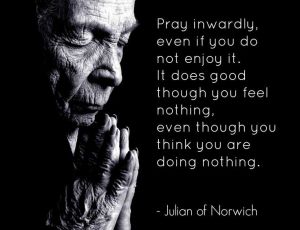
Likewise, our prayers are not always laden with strong emotions. Sometimes we may not “feel” anything, but we pray on because it is time to be with God. We pray out of devotion and duty and love. We pray because we are Christians.

2002fdae745daedbdabb53de82944d04--prayer-changes-things-julian-of-norwich

Number 5: Say the words that need to be said, especially on your worst days. 

Don’t forget to say “I love you,” and “thank you,” and “please,” and “I couldn’t do this without you,” and all the other small-big things that are too easily forgotten. I’m especially bound to forget these things when I’m upset or frustrated. But our words matter, and we need to tell our loved one certain things–even if, and especially if, we just aren’t feeling it that day. (This goes back to point 4: sometimes you have to put your emotions aside.)

There are days I don’t feel like praying. Or if I do pray, I am tempted to rush through the Lord’s Prayer or the collect for the day–I know these prayers so well that it’s easy to rush through without thinking. But it’s important to say those prayers daily.

Why? Because our words matter. Our words, repeated day after day, form us at a deep level. The more we say, give us this day our daily bread, the more we remember that we really do depend on God for our daily strength. The more we say, I love you, the more we recall how much we love God or that special someone in our lives.

18010772_10155405487974750_640712724928749535_n

I’m so thankful to Molly for these lessons. Our relationship has indeed drawn us closer to God. And that’s what marriage is supposed to be about. Marriage is a reflection of the love of Christ for the Church and a foreshadowing of the Last Day when that union will be made complete. The love of marriage, then, should draw us into the depthless love of God. As we grow closer to our partner, we grow closer to our Maker.

Thanks be to God for Molly Hayden.