
Updates from the 81st General Convention in Louisville, Kentucky
June 21-29
Where are we going?
Tuesday, July 2, 2024
At the end of each General Convention, it’s important to seek to discern where the Holy Spirit is calling us as a church, and how this convention moves us down that road. I suppose we all have our own lists of what stands out. Here’s mine:
A decade of collaboration
I’m suspicious of naming decades, but I recently heard someone coin the phrase “decade of collaboration.” It resonated with me. When I served in Stuttgart, I had the privilege of working with yoked parishes (St. Alban’s, Stuttgart and St. Peter’s, Tollville). I also served Emanuel Lutheran (ELCA), and benefited from ecumenical collaboration across the town. In Hot Springs, we have a vibrant ecumenical life between Episcopalians, Presbyterians, and Methodists who come together for worship and service. (We are going to need to lean into those patterns more.) Based on my limited experience, I can attest to the difficulties and graces of collaborations beyond our traditional silos.
General Convention this year saw the celebration of collaboration across dioceses. We have started having conversations about clarity of mission (the first step in collaboration) as we seek to walk forward together.
We no longer have the luxury of staying in our silos. We no longer have the luxury of duplication. We must come together across congregations and across denominations. The Holy Spirit is calling us to greater collaboration for the sake of the gospel. Clearly our Presiding Bishop-elect has some experience with this. I think that’s a big reason he was elected. What collaboration looks like will vary from context to context, but I hope we will have the courage to dive into those unknown waters.
In my limited experience, I’ve learned that it is hard for us to lean into collaboration. Collaboration means we have to lay some stuff down. We have to lay down doing things the way we’ve always done them. We have to be willing to be inconvenienced. We have to be willing to fail, because experiments with collaboration don’t always work at first. Those are three things the church isn’t too good at, but we’re going to need to get better at it.
Unity in Diversity
Unity in diversity is a phrase tossed around at times, but I felt I saw a genuine movement toward unity while respecting our diversity. This should be celebrated because it is a reflection of the Divine Nature. God is Trinity in Unity. The diversity of the persons of the Godhead is brought together in one will, one goodness, one love, one unity. We are caught up in that mystery. Our diversity is not annihilated, but brought together in the mystery of love.
Our church is a diverse place. Our worship reflected the multiplicity of cultures and peoples who belong to The Episcopal Church. Liturgies from our indigenous sisters and brothers are being held up for the good of the church (for example, the prayer to remember the innocents). The Communion across Difference work means that those with traditional views of marriage are still welcome in our church (although there is still more work to be done in this area). We seek to respect them as they respect us. The marriage liturgy presently in the prayer book will be alongside the gender neutral rite. Both are beautiful and moving and worthy of the sacramental rite.
In his remarks at the House of Deputies, the Presiding Bishop-elect encouraged us to move past our disagreements and recommit to unity for the sake of the gospel of Jesus Christ. He encouraged us to forgive, to give each other the benefit of the doubt, and to keep Jesus Christ at the center of our life together. I hope we can do that.
A love letter to Arkansas
I am biased, but we had the best deputation. Our deputation was made up of the Rev. Kate Alexander (Little Rock), the Rev. Peggy Cromwell (Maumelle), the Rev. Annie Jones (Newport), the Rev. Kevin Gore (Jonesboro), Melissa Simpson (Russellville), Rick Williams (Pine Bluff), Bay Greenhill (Siloam Springs), Marvin McClennon (Little Rock), and James Crews (Pea Ridge). We also appreciate our Bishop for joining us in our discussions and prayer. They represented Arkansas well, and I learned how to be a more faithful Christian from them.
There’s a lot of work that goes into being a deputy. We met for months to prepare. We read reports and summarized findings for one another. We researched resolutions and discussed positions. We prepared for elections and prayerfully discerned for whom we should vote. We spent hours in legislative sessions, supporting one another and helping one another discern the movement of the Spirit. Most days, we left our hotel rooms at 8 am and didn’t return until at least 12 hours later.
Going to General Convention is a vocation–a calling to respond to the Holy Spirit in a particular way at a particular moment. I’m glad these good folks answered the call.
[Final] Legislative Wrap-Up 3: Governance & Administration (and how the Rev. Garrett Boyte saved the church)
Saturday, June 29, 2024
Alright, last legislation review. A big conversation this General Convention was around our structures as a larger church. I’m convinced that our governance and administration are too corporate and top-heavy for what we need. We need a leaner church with a network-driven and adaptive approach. Over the course of this last week, our conversations became more intentionally focused in that direction, and discussions increasingly centered on what our governance and administration should look like for the sake of the gospel of Jesus Christ, as Bishop Rowe is clearly fond of saying.
Let’s start with some of my assumptions. Administration is not a bad thing. It’s needed, but it needs to be right-sized. Administration, properly understood, is about supporting ministry (those are the Latin roots of the word, after all). In the same vein, institutions are not a bad thing. Institutions serve and enable the ministry and mission of the church. They make us effective and are integral to who we are. Without the institution of the Church founded by Christ and empowered by the Holy Spirit, we are left with a do-gooder “theology” that abandons the foundations of our hope. If we are not careful, however, we can make idols out of our administration and institutions, forgetting that they are there to enable our effective sharing of the gospel with the world and instead propping them up because “we’ve always done it this way.”
It should be said: We do this at every level of the Church, from the parish, to the diocese, to the larger Church. And we should resist it. Bishop Sean Rowe is the right person to lead us into that future.
The vocation of the larger Church is to support and empower dioceses and parishes in their sharing of the gospel of Jesus Christ, and to unify us as one people for our collective witness in the world. The Presiding Bishop-Elect believes that, too. It’s for that reason I strongly disagree with this article from Patheos. It doesn’t accurately reflect what we discussed at General Convention, both on and off the floor. Diocesan and parish revitalization is a top priority.
Rules of order: An overlooked area where we are doing this work has to do with the rules of order for the House of Deputies. The rules of order govern how we conduct business. There was a temptation to go back to pre-pandemic Convention norms (10+ business days instead of 6), as embodied in D048. The Convention pushed back. Work will continue to be done online before Convention so we can have a shorter period of time together. Testimony will be solicited from across the church in both written and spoken (via Zoom) forms. The message is simple: Let’s get as much work done together, as effectively as possible, before Convention so we can dive into those things that must be done in person. (Now if only we could get more on the consent calendar and make it harder to get stuff off. They tried.) This will also ensure greater participation across the church. You don’t have to be a deputy and travel to General Convention to testify or participate in the legislative process, and that’s a good thing.
My hope is that the effect of this work will be to limit the number of resolutions we consider, because the larger church doesn’t have to do everything. It will give us a clearer sense of what we have been called to do as a General Convention, and encourage us to empower dioceses and parishes for their own ministries.
Diocesan Restructuring: This General Convention approved the juncture, or merging, of three dioceses in Wisconsin and two in Michigan, as well as those in Micronesia with Hawaii (D051, C025, and B006). These were joyful moments this week. Wisconsin and Michigan, in particular, have lessons learned to share with the larger church. They are coming together to make their ministry more effective. Again, they are leaning into those network-driven and adaptive assumptions instead of corporate models, seeking to reduce duplication and focus resources on mission and ministry. I hope others will consider learning from them.
It would be helpful if we identified some best practices indicating when dioceses should consider juncture and how to get started and go about it. The Presiding Bishop-Elect has considerable experience leading these conversations.
In addition, Navajoland became a missionary diocese this week (C009). That is wonderful and long overdue! They have done some good work to prepare for this moment. I wrote about this earlier this week, but I will add that supporting Navajoland and our Province IX dioceses is the right thing to do. We should have conversations about how we do that, but we should not abandon that work. To do so would be to abandon part of the Body of Christ.
Parish Revitalization: This must the heartbeat of all we do. We are beginning to focus on some data-driven initiatives about what’s working and what’s not, and I’m excited to see the fruits of A044. The Patheos article cited above gave it a bad rap, but we’re ready for the work and there are some good minds engaging it. My advice for those nay-sayers: Get involved with the work. We need you to be part of the conversation.
Parish Membership: Finally, a note of thanks to my friend the Rev. Garrett Boyte. He was watching the proceedings and read A108. It passed the House of Bishops without comment, which was curious since its original draft changed the membership canon (1.b) to require confirmation or reception for Adult Membership. That goes against our core theology of Baptism as full initiation by water and the Spirit into the Body of Christ, the Church, and the committee should have known that. Confirmation and reception are encouraged, but never required for membership; they are mature affirmations of faith, not baptism 2.0. I suspect the deputies would have passed it on the consent calendar, too. But because of Garrett’s diligence from afar, I was able to work with a couple of others to get that corrected in committee. Our baptismal ecclesiology has been saved, and this episode is a beautiful example of how folks are engaged at home. Thanks, Garrett.
Legislative Wrap-Up 2: Social Justice (and Israel/Palestine)
Saturday, June 29, 2024
Each General Convention we consider a host of social justice resolutions. There are two committees dedicated to such resolutions, one focused on domestic policy and the other on international policy.
So why are social justice concerns part of our work? Christ calls us to care for and engage the world around us, especially attending to the needs of the oppressed and forgotten. We are called to witness to the love of God, to our hope in the Kingdom that is coming soon, and to the promise of restoration even amid chaos and despair. These resolutions should do that and should give Episcopalians some action items. They should address how we, as the church, are going to seek to respond. In that way, these resolutions can take General Convention into a prophetic stance, where we seek to tell the truth about the world and about the God who has promised to make all things new.
But it is hard for a body of over 1,000 people in two legislative houses to agree on that stance. We disagree, and it is virtually impossible to get to a purist position. This is made more difficult by some practical concerns. A primary one this go around had to do with The Episcopal Church’s ability to lobby lawmakers. If we’re going to authorize the Church to lobby lawmakers, we must use precise, legal language when issuing mandates. We fought a great deal about that issue with respect to the terms “genocide” and “Apartheid,” both of which have precise legal definitions and which have not yet been used by key international authorities.
We considered a host of social justice issues, from just war (A018) and religious nationalism (A081), to gun violence (D011 and D014) and water rights (D008 and A167), to reproductive rights (D031) and book bans (D039). I should note here that it felt like we did not consider many beloved community and anti-racism resolutions compared to previous years. That is in large part due to the work we did in Baltimore at the 80th General Convention. We established something called the Episcopal Coalition with a clear funding formula that is continuing to engage that work faithfully.
Our main focus, naturally, was Israel/Palestine. It’s not hard to see why. The attack on October 7, 2023, the deadliest attack on Jews since the Holocaust, continues to rend our hearts. We pray for the hostages and their families. But so, too, does the ongoing violence in Gaza. We pray for the thousands who have died in innocence, victims caught in a spiral of violence, used as human shields by terrorists and considered collateral damage by Israeli leadership. While the war has brought new attention to Gaza and the Palestinian people, this violence is much bigger than what we’ve seen in the last 8 months. It stretches back decades.
I’m no expert on this. I don’t pretend to be. I’m suspicious of most folks who claim to be. But I am grateful for a mentor of mine, the Rev. Leyla King, who is a Palestinian American and an Episcopal priest. Her voice is one I listen to. Visit https://thankfulpriest.com/.
We passed resolutions D007, D013, and D056. They were passionately debated in both houses. We did so respectfully and prayerfully. In the end, I believe our process was faithful in that way. However, we were left with a series of resolutions that felt incomplete to many. I encourage you to read them and prayerfully consider them.
We should be clear: these resolutions will do little to impact what’s happening on the ground. If that’s our end goal, we are lost, for we are not the Congress. But these resolutions may impact the church and our action in the world, and if that’s the goal, then we might be on to something. My frustration is too often these resolutions are proposed without those action items.
So on Israel/Palestine, I will continue to engage, and I hope you’ll join me as you feel called. And I hope you’ll share your thoughts with me. Instead of debates in legislative bodies, we need to have good human conversations about this that allow us to meet one another at the level of the heart and soul. Here’s what I’m feeling called to do right now:
- First, I’ll continue to pray for the peace of Jerusalem and all the land, lifting up the sorrow in the Holy Land to our God who hears us.
- I’ll be intentional about listening to Christians in the Holy Land. Before I go to my favorite political pundit over here, I should be more interested in what the Anglican Archbishop of Jerusalem Hosam Naoum has to say. I think that’s a good practice for all of us, wherever we might fall on the political spectrum.
- In light of that, I’ll prayerfully reconsider what I might believe. God calls us to have hearts of flesh, not hearts of stone.
- Like St. Paul, I’ll send money to Jerusalem—in my case, to the Anglican Province of Jerusalem and the Middle East. They need our help. You can send them money here.
- I’ll call my representatives in Congress and implore them to work for a ceasefire.
A prayer for social justice (BCP 823)
Grant, O God, that your holy and life-giving Spirit may so move every human heart [and especially the hearts of the people of this land], that barriers which divide us may crumble, suspicions disappear, and hatreds cease; that our divisions being healed, we may live in justice and peace; through Jesus Christ our Lord. Amen.
Legislative Wrap-Up 1: BCP and Worship
Friday, June 28, 2024
Well, I was too tired to write anything yesterday. On top of that, when the House of Deputies wants to move, we move. And we started to move! We wrapped up today, but I’m not finished reporting what we did back home. I’ll have a couple of posts for legislative wrap-up. Today’s focuses on the prayerbook and worship.
I should note that I’ve enjoyed worship here. It has reflected, I think, the breadth of The Episcopal Church. I’m especially grateful for Theodicy Jazz Collective out of New Orleans for musical offerings. Before folks back home ask, we can’t afford them for the Jazz Mass!
Legislatively, some big things happened. The biggest was A072 and B008 which gave guidance on authorization of liturgical texts and future prayerbook revision. The legislation cleans up the authorization process, but also gives us a piecemeal approach to prayerbook revision. Going forward, I think it’s fair to say the goal will not be a brand new book. Rather, the prayer book will be understood as the library of authorized resources. In other words, we will have BCP 1979 (what we’re used to), but also access to a host of other rites, including new Eucharistic prayers. Examples of these additions include the new expansive language prayer C (A114), inclusive marriage rites (A116, A160, and D035), and changes to the Good Friday liturgy (A115). We should note, however, that there is a high standard for prayerbook revision. A proposed liturgy must pass two successive General Conventions.
The marriage equality resolutions were more moving than I anticipated. We’ve had marriage equality for some time in The Episcopal Church. But right now, those rites are just authorized. They are not part of the Book of Common Prayer. Because of A072, we started the process of including that as part of the official BCP. That puts some meat on our equality claims. It was moving, indeed, to see my LGBTQ+ friends across the House shed tears of joy at our routine votes. It was also a joy, indeed, to see the margins these things passed by: near 100%.
A brief aside: A question presented at this General Convention is what does memorialization mean? I’m still not clear on it, although the House forged ahead with some constitutional language that would enshrine the term in the constitution if passed at the next General Convention (A224). I thought that was a mistake and that the question should have been referred to an interim body. For some context, in 2018 we “memorialized” the BCP 1979 as it existed in 2018 (2018-A068). That seems to mean it will continue to be available for worship as it was in 1979. More conversation is needed around that.
A big disappointment was the Communion across Difference work. The task force was authorized to bring together those with progressive and traditional views of marriage. Their task was to help the Church chart a way forward together. They did great work. One of their resolutions, A092, passed, and protects those with traditional views from discrimination in ordination and deployment. That is a very good thing. But the work needed to continue; we are all needed in God’s church. Unfortunately, it won’t, at least not as a task force (A094, which would have continued the task force, was not adopted). But there are plenty of us still committed to walking together in love, even if we have passionate disagreements about marriage equality.
There were also a series of resolutions about full communion (or greater communion) agreements with other churches, especially the Presbyterian Church USA (A042) and the United Methodist Church (A049). We are far from finished with those, and I’m happy to discuss the details with you. There’s still some theological language to work out so we can remain faithful to our own inherited traditions, but I’m in favor of coming closer together as we strive to embody Christ’s prayer that we all “may be one” (John 17:21).
A final worship note: the Presiding Bishop-Elect has announced he will not have a big installation service at Washington National Cathedral in November. Instead, there will be an intimate service at the chapel in the church office in NYC. The service will be live-streamed. This is a good decision. It saves cost, and the PB-elect noted it is also environmentally-conscious.
I think it is entirely appropriate to have big celebrations for bishops in our dioceses. We could pare that back a bit, but they are often a tangible sign of turning a new leaf in the life of a diocese. And we should not forget that they are ordinations–bishops are ordained. One is not ordained Presiding Bishop. It is meet and right liturgically to have a marked difference between a bishop ordination and a Presiding Bishop installation, just as a priest’s ordination should be different from a celebration of a new parish after a call.
Tomorrow, a wrap-up on other items, including administration/structure and Israel/Palestine conversations.
A New PB!
Wednesday, June 26, 2024
Today was a day off for me (mostly), so I rested a bit by spending time with friends. I had lunch with a couple good friends, and then I walked to Indiana with some friends. Indiana was one of 8 states I hadn’t visited, and I figured walking there would count. It rained. I got soaked.
But what a day to miss! I was in the alternate gallery for the big announcement. The Rt. Rev. Sean Rowe of northwestern Pennsylvania and western New York was elected on the first ballot to be our next Presiding Bishop. I am thrilled with this election, and I’m not the only one. At 49, Bishop Rowe is one of the youngest bishops in the House of Bishops and the youngest ever elected as Presiding Bishop (William White was younger, but he wasn’t elected). Rowe was ordained a bishop at 32, so he also has more experience than most bishops in the House. (And yes, 32 is incredibly young to be elected bishop.) He is a faithful Christian and leader. Over and over, those who have served in his dioceses rave about him. He is particularly attuned to mission and ministry impact. He has key administrative experience we need, such as leading dioceses toward merging in holy ways. He wants us to be more network-driven and mission focused. He wants us to support dioceses and parishes.
Bishop Michael Curry will be missed. Bishop Rowe is not him. They do not have the same gifts. That’s a wonderful thing. The Holy Spirit calls the people needed to the present moment. Curry was that person 9 years ago. Rowe is that person now. Over and over in his remarks he emphasized where we are being called to ministry together, and doing all for the sake of the gospel of Jesus Christ. He is clear-eyed about the challenges that face our church. But he’s also hopeful. He is not fearful of the unknown. He said, “We don’t exactly know what that is or what [the church’s future] looks like. What we know is that God is in the midst of it and that love is the way, and if we continue to live and move ever more deeply into those ways that the world can transformed around us in Jesus.”
To that, I say, amen. Bishop Rowe will be installed as the 28th Presiding Bishop of The Episcopal Church on the feast of All Saints’, November 1.
I will add: this must be a reminder to our Church to take young people seriously. Rowe was ordained a priest at 24, which made him, for a time, the youngest priest in The Episcopal Church. Then he was the youngest bishop. Now he’s the youngest elected Presiding Bishop. And he is exactly who the Spirit is calling and who we need. Invest in young people, whether lay or ordained. I am grateful that no one stopped me from entering the ordination process when I was in my early 20s. I was supported by my bishop, sending priest, and sending congregation. Since ordination, I am grateful for all who have taken a chance on this young buck, especially St. Luke’s, Hot Springs; St. Alban’s, Stuttgart; and St. Peter’s, Tollville.
A little background on the process is warranted. The Joint Nominating Committee for the Election of the Presiding Bishop was an incredible group that did incredible work. They represented the church, from young people to retirees, from seminarians to those in the armed forces, and included laity, deacons, priests, and bishops. Arkansas was represented well by Thomas Alexander. This process produced five candidates who are all faithful and resolved to support one another. They meant it. It is a breath of fresh air, indeed, in our polarized world where everyone is trying to get the last word.
The House took other actions today, as well, including Israel-Palestine and Article X revision. I’m going to table those until tomorrow.
Budget, PHoD, and Navajoland
Tuesday, June 25, 2024
Another long day. For the past two days, the legislative calendar (resolutions we debate on the floor) didn’t move too quickly. Today we picked up the pace, passing a budget and several resolutions. Perhaps the deputies realized we only have so much time, and just because you are passionate about something doesn’t mean we need to talk about it for an extended period of time.
First, however, we heard from the Joint Nominating Committee for the election of the Presiding Bishop. More about them tomorrow. Suffice it to say they have done good work. The task force is representative of the church in so many ways, and their work has produced good fruit.
We also re-elected the President of the House of Deputies (PHoD), Julia Ayala Harris. There’s been a bit of controversy about this. You can read all about it in ENS. President Ayala Harris was accused by Vice President Tabor Hamilton of being a bully, non-responsive, a poor leader–and on and on. The deputies didn’t seem to buy it. I certainly didn’t. I’m not enough of an insider to have any special knowledge, but I thought Ayala Harris was the right person for the job. She’s doing well under difficult circumstances, and keeping her in leadership will provide some stability as we select a new Presiding Bishop and Secretary of the General Convention. Moreover, she is clearly faithful and a person of prayer. I’m thankful she’s in the chair.
One area where I have been impressed with President Ayala Harris is she knows when to move something along and when to slow down. As President, she has a great deal of discretion. Within limits, she can call for a vote and end debate. She does that often, and that keeps us on track. But at other times, she slows us down so we can hear important testimony.
Today, Navajoland Area Mission became a missionary diocese (C009). This will mean they will elect their own bishop. They will have a vote on the House of Deputies floor. They will be able to participate as full members of our Church. It’s been a long time coming. They said that being Dine and Episcopalian go hand-in-hand for them. They said they want to continue to learn, and they want us to learn from them. They want to live into the community of dioceses as partners and peers.
The moment was particularly moving. They all told their stories of how they got to this moment, and how the dream of their late indigenous bishop Steven Plummer is being realized by this move. The Diocese of Alaska, which has a high indigenous population, presented them with a gift. The House greeted them with a minutes-long standing ovation, and this starchy deputy nearly shed a tear.
In a parallel move, Episcopalians in Guam and Saipan (formerly collectively known as the Episcopal Church in Micronesia) will now be part of the diocese of Hawaii (B006). That’s wonderful. There is a small presence on each island, and they have a long connection with Hawaii. It’s good for our bonds of affection to be recognized in our diocesan structures. Now those small communities in Guam and Saipan will have a greater voice, not only in diocesan life but also in the life of the larger church.
Tomorrow is a big day. The House of Bishops will elect our next Presiding Bishop from a slate of five. I have the day off, but I’ll be there to watch when the result is announced to the House of Deputies from the Alternates section. I am excited to see where the Holy Spirit is taking us.
Money matters
Monday, June 24, 2024
Today was a long day, but an important one. General Convention can do a lot of things. But one of our most important functions is a monetary one. Through our work as a Convention and in committee beforehand, we draft a budget and set priorities. Resolutions call for monetary allocations, though most of the time this is simply a wish by the proposer and committee (in other words, just because a resolution is passed does not mean there will be enough money to fund it). We heard the presentation on the budget this morning, and we will vote on it tomorrow (A164).
And let’s face it: money is a primary concern. We ignore monetary concerns at our peril. In my view, this tends to look one of three ways:
- It can be popular around here to say that ministry should determine budget instead of budget determining ministry. That’s just magical thinking at best.
- Additionally, General Convention, it seems, can sometimes fall into the trap of just assuming money is there, or not wanting to admit that something, no matter how worthy, is just not possible right now. Ask our dioceses and parishes that don’t have the luxury of having millions of dollars in endowments–it’s hard, but it’s necessary to have that kind of clarity.
- We also often fall into the trap of assuming the larger church must do everything. That’s not good governance. Some things are the responsibility of dioceses and parishes, and the larger church should focus on those things that are pertinent to its calling and mission. We need to get clear about this.
To that end, several dioceses, including Arkansas, came together to encourage a conversation about our diocesan assessment in resolution C008. At present, dioceses pay 15% of operating to the larger church. We asked for a 10% tithe instead. We debated hard, but in the end it failed miserably. Here are a few reasons I thought it was a good idea:
- I believe ministry is most effective at the parish and diocesan levels. That’s where disciples are made–in congregations, at diocesan camps, at ECW gatherings and men’s retreat, etc. The larger church has a vocation that should be celebrated, but it is secondary to making disciples.
- Without reform, under-resourced dioceses, and by extension parishes, are going to be left behind in rising waters. In the end we will be left with well-endowed and predominantly white urban and suburban congregations, wringing our hands and wondering what went wrong.
- Our administration is clunky. It’s corporate. It’s outdated and needs to be streamlined and network-driven. We don’t need a staff position for every initiative, no matter how noble. The narrative budget admits as much.
- The resolution gave us a decade to do this work. It did not call for an immediate reduction, and deputies may have been confused by that. It also gave maximum flexibility to Executive Council and executive officers to determine how to meet this goal. That’s good governance.
- Finally, if we live into the abundance of the tithe at the larger church, diocesan, and parish levels, we will have more than enough.
So now what? Well, we continue to work. We continue to encourage more network-based solutions and push back against top-down, corporate assumptions. We invest in parishes and dioceses, and we get clear that our most important work is worship and making disciples in those places. We work to support those dioceses and parishes that are struggling in whatever ways we can. We keep talking about it, and we seek to be good stewards of the gifts God has given us.
On a related note, I was elated that A101 passed overwhelmingly. The denominational health plan is wonderful but expensive, and it is a real burden for churches. A101 will get us on the path toward more affordable coverage by removing inappropriate subsidies for platinum plans and high cost of living areas. The bishops, I hear, may have some quibbles with some of the language, but I’m hopeful it will pass there, too, with minimal change. I was honored to be a small part of this effort as the secretary for Agencies and Boards.
Church and Connection
Sunday, June 23, 2024
A theme for me today was connection. General Convention, at its best, makes connections across the church and is a tangible sign of our bonds of love. At this convention, 108 dioceses have gathered with their 813 deputies.
We began today, as is meet and right, with worship. (Click here to see the bulletin.) All of the worship was not my cup of tea. That’s okay. Worship isn’t about us anyway, and that’s a hard thing for Episcopalians to lean into. But our worship did a good job of was highlighting the multicultural diversity of this beautiful church. This was especially seen in the hymnody and music. Hymns were sung in Spanish and in English. One hymn by Helen Kim reflected the musical heritage our Asian siblings. A big hit at worship was “Precious Lord, take my hand,” again in both Spanish and English.
Our connection was also seen in some of our traditions. A Bible is placed at the front of the House of Deputies to remind us of our connection to Holy Scripture. This year, the President’s chosen passage is Numbers 27:1-8, which challenges us to see how God is ever breathing new life into our understanding, leading us to greater inclusion and empowerment. The President asked how God might be calling us to widen the circle and to break down barriers so all can find a place and purpose in our church.
And connection is seen in our legislation. Parliamentary procedure gets a bad wrap, but it’s really about how can we preserve a space so we can all participate in a conversation. Parliamentary procedure, at its best, is about making sure we listen to one another. We had one moving moment in particular as we were discussing D014. A member of the official youth presence reminded deputies that he has become an unwilling expert on gun violence after his school had a shooting. He said that the youth are having to learn to bury the bodies of their friends because of our inaction.
On the less moving side, a big chunk of our time was debating how and what we would debate in the coming days. One proposed change was to keep more things on the consent calendar. The consent calendar is a legislative tool that allows us to consider multiple resolutions at once. Essentially, we vote to go along with the vote of the committee. The new rules said legislative committees could not vote to take something off of the consent calendar. While I liked that change and voted for it, the House voted that down. We trust our committees, and we are deeply suspicious of anything that might curtail their authority.
Tomorrow is a full day. We begin with a budget hearing, followed by two resolutions I have worked on. A101 is about the denominational health plan and controlling costs. C008, as reported yesterday, is about changing the diocesan assessment from 15% to 10% (we were supposed to get to that today, but ran out of time).
A Good Beginning
Saturday, June 22, 2024
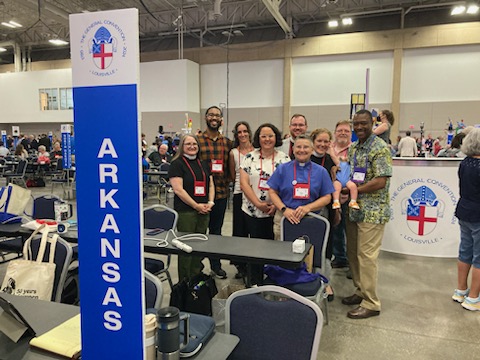
Today was the first day, and much of it was dedicated to orienting deputies and bishops to our work over the next week. There’s a lot of technology that goes into having 800-person conversations in the House of Deputies, and I’m grateful for all of those who have endeavored to make sure the House has what we need to be productive.
Of course, I hasten to say that today was not the first day of business. We’ve been doing business for months. Before today, we have had 55 hearings and have heard over 2,500 testimonies from across the Church. That was never possible before Covid because testimony was at GC in person. Technology has allowed us to democratize the process, and that should be celebrated.
A few highlights from today:
Worship
Tonight we had a revival at the YUM center. It was not a Eucharist. It was a service of music, word, and prayer, with a sermon from Presiding Bishop Michael Curry. It goes to show that we can have church without the Eucharist (although we will have a Eucharist tomorrow on the Lord’s Day, for it is meet and right so to do). Having the revival at the beginning of Convention is meant to ground us in prayer and worship. While debating resolutions and electing people to serve in various offices do not look like typical Sunday morning worship, it is, indeed, worship. It is offering ourselves to God as a Body.
This was my first revival. They have been a hallmark of this Presiding Bishop’s tenure. Time will tell if they continue, and I expect they will in some corners. But the next Presiding Bishop is unlikely to have Curry’s same gifts. They will bring their own. I am grateful that the Presiding Bishop has exposed this sometimes frozen church to more emotion in her worship–even if this former Pentecostal boy resists.
Budget
It’s like whiplash to go from revival to a budget hearing, but General Convention is a place where those two things go hand-in-hand! There was a canonically required budget hearing this morning. At the last Convention, the Church adopted a new budget procedure that frankly makes more sense. But there are going to be some growing pains. Deputies do not have the same degree of freedom they once had to influence the budget, and that can cause some frustration.
Speaking of the budget, a resolution I wrote, C008, is on the floor tomorrow. It will ask the Executive Council to reduce diocesan assessments (what dioceses pay to the larger church) from 15% to 10% over the next decade. I think its responsible governance. It will come with difficulties, but we’ve already had to engage this difficult work at the parish and diocesan levels. Even so, there will be a good degree of pushback with opponents claiming we will be gutting ministry programs. That’s untrue. The Church has the authority to make cuts where it must (administration, especially), while preserving ministry priorities. Indeed, it will make us get clear about our ministry priorities and our impact.
Leadership
There are two questions floating about leadership. Who will be the next Presiding Bishop? I have no clue–I’m not a bishop. And who will be the next President of the House of Deputies. Julia Ayala Harris has my vote. She was elected two years, and in a nearly unprecedented move she is being challenged immediately by two others. I won’t speak against them, but I will say that President Ayala Harris is the right person for the job, and I hope we reelect her.
Both President Ayala Harris and Bishop Curry addressed the deputies and bishops. Presiding Ayala Harris reminded us that what we do is rather counter cultural. In an ever increasingly polarized world, we seek to do our work while respecting the dignity of others, even those with whom we disagree. We keep our allegiance to Jesus Christ and the mission to which we have been called.
The Presiding Bishop has retirement on his mind (he will officially retire October 31). But he encouraged the Church to remember that God isn’t done with us yet. Our job is not to worry about the future, but to roll up our sleeves and get to work. Just follow Jesus, trust the Holy Spirit, bring our best to God, and proclaim the Gospel one way or another. If we do that, we will be just fine.
Arkansas is in good hands
One final note: I am grateful for my colleagues. We have a wonderful and collegial deputation that is doing the work. We come from different places with diverse experiences, and we have the trust to share our opinions and ideas with one another. We are all grateful for our bishop, who has joined many of our conversations.
Why General Convention?
Thursday, June 20, 2024
Since this last Monday, Molly and I have been in Louisville, Kentucky, for a little vacation. We are big bourbon fans, so we’ve gone to several distilleries along the Bourbon Trail to learn the process and the unique histories of some of our favorites. But starting on Saturday, I’ll be back in work mode. I was elected to serve as a deputy from the diocese of Arkansas at our diocesan convention in 2023. I’ve been looking forward to this work since then.
Part of my calling is participating in the governance of the church. At my priestly ordination, I promised my bishop that I would take my share in the councils of the Church. That can look any number of ways from priest to priest, but for me, it has looked like taking an active role in General Convention and the Executive Council of the diocese. (This is my second General Convention. You can find my reflections from the 80th General Convention in Baltimore here.) It’s something I genuinely enjoy doing, and I think God has given me some gifts to do the work well.
The General Convention is the highest authority in The Episcopal Church. We gather every three years to consider legislation and resolutions, to set budgets and ministry priorities, to consider changes to the Prayer Book and other worship resources, and to hear where the Spirit is calling us. You can read those resolutions here. This work is importantly set in the context of worship and prayer (although we could probably do a bit more of this). Each diocese sends its bishop or bishops to sit in the House of Bishops. Each diocese also elects four clergy deputies and four lay deputies for the House of Deputies. And in the end, it can be a clunky thing. It is not streamlined and there are plenty of inefficiencies. With a shorter schedule since the Covid convention, it feels even more rushed. At the same time, it feels more drawn out. We have been meeting over zoom for committee meetings for a few months now–another change since Covid.
But why have we chosen to go through this process? Why not just leave it up to each local parish or even diocese to decide these things? Why do we need a larger church at all?
We believe that we are one body. That body is bigger than the local parish, and our bishop is a reminder of that. The Body of Christ is bigger than even The Episcopal Church. But for us Episcopalians, we gather as a whole body every three years to work together simply because God has called us together. Naturally that unity can be messy and even clunky. We gather from across states and countries, from across political persuasions, from across the theological spectrum. We gather with plenty of differences. But in our polarized world, we choose to gather and bring all of that difference with us, trusting that the Holy Spirit will speak unity in the midst of our diversity.
But more than that, we believe that the Holy Spirit speaks to us when we gather together. We believe that we can be more faithful to God’s call when we gather in our clunkiness and messiness and seek to walk together in love. It’s noteworthy that not just bishops gather. Instead, we have chosen to gather bishops, priests and deacons, and lay people to make decisions on behalf of the whole church. It’s a beautiful thing–messy and clunky, yes, but also beautiful.
I am grateful to have been elected to this work. For those who elected me back home, thank you for putting your trust in me. Reach out with your concerns and questions. I’ll try to be responsive. You can also check back here every day for my reflections on what we’ve done. Most importantly, I ask for your prayers for me and all who have gathered. Pray that we would have the grace to hear and follow where the Holy Spirit is leading us.
 Storied Grace