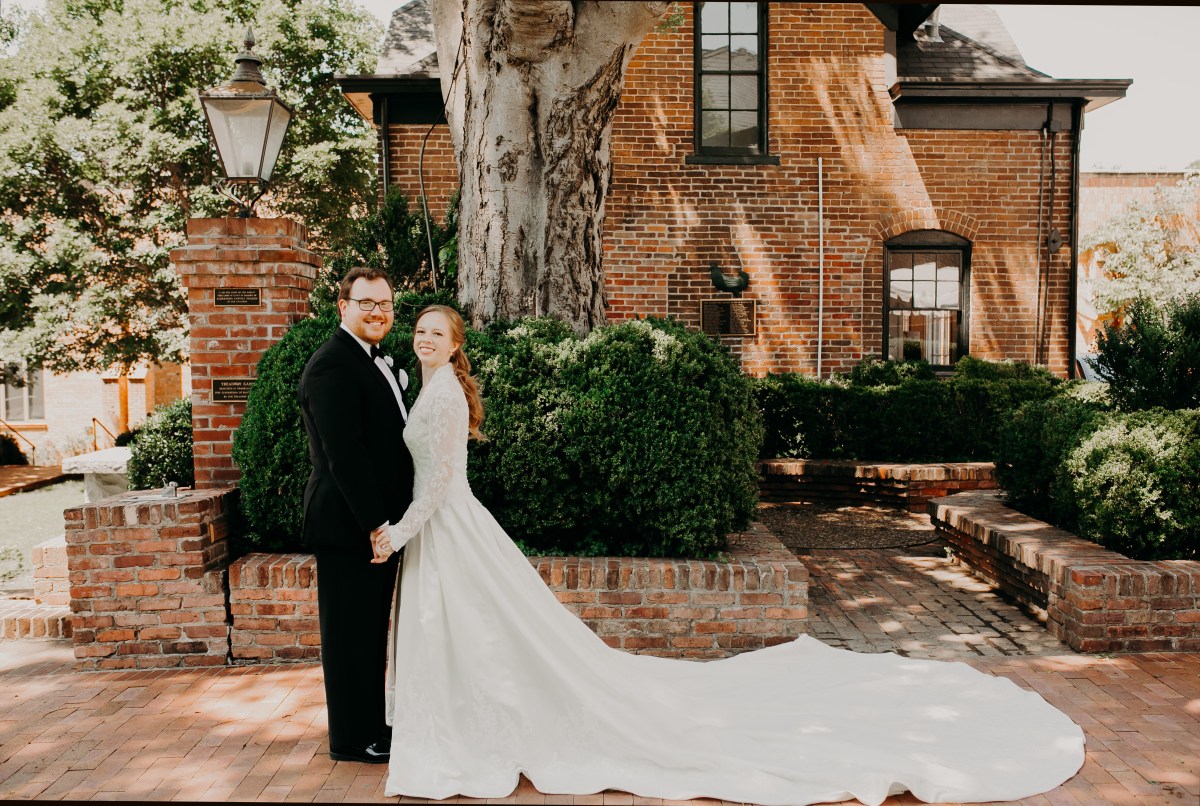
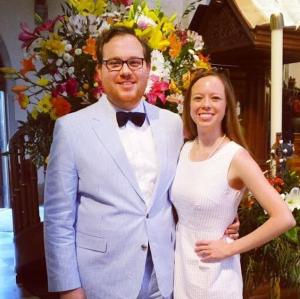
I wrote this hymn text on the eve of my marriage to Molly, July 7, 2017. It was revised July 8, 2018, on our one-year anniversary to give it a more common meter. It is set to Creation, which can be heard here accompanied by its usual text.
Oh Love, the Word of God that spake
The worlds to be and dark to day:
Look down on these who vows now make,
And give them grace on this new way.
Oh Love, the Word, Eternal One,
Oh Love, our Lord, the only Son,
Oh Love, whose promised Reign shall come,
Create in them one heart today.
Oh Love, the Son of God above
Who took on flesh the world to save:
Bless these who promise all their love,
And on their hearts your love engrave.
Oh Love, the Word, Eternal One,
Oh Love, our Lord, the only Son,
Oh Love, whose promised Reign shall come,
Help them to love until the grave.
Oh Love, our King, whose promised Reign
Is light and love and endless day:
For us let these two be a sign;
Inspire our hearts and minds, we pray.
Oh Love, the Word, Eternal One,
Oh Love, our Lord, the only Son,
Oh Love, whose promised Reign shall come,
Make us your bride for that Great Day!
THE FEAST OF THE TRANSFIGURATION
August 6, 2017
Trinity Episcopal Church
Searcy, Arkansas
Readings: Exodus 34.29-35
Psalm 99
2 Peter 1.13-21
Luke 9.28-36
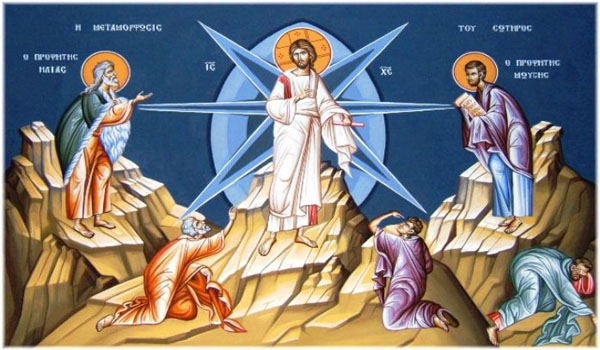
In today’s Gospel reading from Luke, Peter, James, and John, the iconic three disciples, are shown something beyond their wildest imaginations, something that stunned them, that shocked them, that no doubt confused them. They see Jesus transfigured in radiant light, dressed in dazzling white, speaking with Moses and Elijah on a mountain.
In that moment, they caught a glimpse of the divine nature of Jesus, the Word of God. This divine nature was always there–it wasn’t anything new, because Jesus had always been fully God and fully man. Maybe they had seen glimpses of it before on the road, as Jesus taught and healed the people. But they had never seen it quite like this.
An icon of the Transfiguration.
Peter’s response has always stuck with me. Let us build three dwellings, one for each of you. Now why in the world would we do that? Peter, just a few verses earlier in the same chapter, had confessed that Jesus was the Messiah of God, the Christ. But he does not yet appear to understand what he confessed. He does not understand that Jesus is shining with the Light of who he is: God Incarnate. Peter, only a few verses earlier, had heard Jesus tell of his death and resurrection in Jerusalem. But he does not seem to understand that yet, either. Peter does all manner of works in the Name of Jesus, has seen healings and miracles and signs galore, confesses Jesus as the Messiah and is named the Rock on whom the Church will be built; and yet, Peter suggests building three dwellings, he will deny Christ three times, and he will flee as Jesus hangs on the cross.
Peter has seen a revelation of who Jesus Christ is. But his response reveals that he comes down off the mountain, not with clarity of vision and purpose, but confused, feeling his way in the dark, still trying to figure all of this out, maybe with more questions now than ever before.
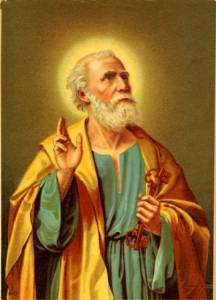
St. Peter may be the patron saint of those of us who like to take two steps forward, one step back; those of us who feel our way in the dark, trusting in God, but maybe trusting in ourselves a little (or a lot) more; those, like me, who think we have it all figured out, the world by the tail, only to fall flat on our faces.
But, my friends, that’s what faith looks like. Faith is a journey with God. It is getting up each and every day and dedicating ourselves to continuing down this road with Jesus, even when–especially when–we don’t know where the road is going. Faith is putting all of our trust and hope in God, and knowing that we are forever held in that Love and Peace that passes all of our understanding, even when we have no understanding. Faith is returning to God, time and time again, when we fall down, when we can’t make out the future, when we get caught up in other things and neglect our relationship with God. Faith is not something static. No, faith is dynamic; it is something that grows in us as we grow into our relationship with God. Faith does not mean we have it all figured out. By no means! No, faith means we are going to stay on this path, we are going to put our hope in God and God alone, despite not understanding everything.
That’s St. Peter’s story. Two steps forward with Jesus, and then one step back. But then he gets up and continues on.
Faith like this takes incredible courage and strength. It is hard to trust, if we are honest with ourselves. If you’re like me, it is difficult, sometimes it feels impossible, to hand over the reins to someone else–even God Almighty! No, I’ll continue on my own. I’ll figure it out by myself. I’ve got this handled.
But when we realize that we can only depend on the grace of God to see us through; when we give God our concerns, our worries, our trials; when we make that difficult step, things begin to happen.
You know, searching for a rector, going through a transition like this for as long as you have, can seem like feeling your way in the dark. Maybe you feel a little bit like St. Peter on the mountain before the spectacular show of light, sitting there in the dark, not knowing quite what to do, perhaps feeling a little confused, just trying to stay awake. Or maybe you feel like St. Peter coming down from the mountain after the Transfiguration, still in the dark, still confused, still trying to figure it all out. It can be tempting to despair after a while, I think.
But Jesus is in this. Maybe, on this mountaintop of transition, he is showing you something deeper, calling you to a new place, preparing you for something new coming down the road. Maybe you won’t recognize it at first; it might take time to see the effects. There may not be clarity right now, and questions may remain; but Jesus is still the Chosen, and he’s still with us.
Look for Jesus. Keep walking with him. Put your faith in his never-failing grace and endless love. And prepare to be blown away by the unexpected.
It hit me all of a sudden, like when you wake up one ordinary day and realize it’s already Spring. I realized that my relationship with Molly had transformed my prayer life.
Molly and I have always lived at some distance from one another. As our relationship moved from friendship to romantic love, I was aware that we were in for a challenge. Because I’m a nerd, I had read some research literature on the topic. There’s a summary of this research on fivethirtyeight.com. Briefly, long-distance relationships, while not doomed to fail, tend to be shorter and more prone to idealization–or making the partner into some idealized version of herself, which, as you might guess, is not good if you’re going for a healthy relationship.
Molly and me at Subiaco Abbey, AR, where we met. Photo credit: Caitlin Trickett (caitlintrickett.com)
But here we are, getting married this week! I’ve chalked this up generally to our communication habits. To get more specific, there are several things that have not only kept us together, but have also strengthened my relationship with God.
Number 1: Take time to let your relationship grow.
A seminary dean once told a group of fresh seminarians that the best relationships are Crockpot relationships. Ditch the microwave approach and take the time to grow into stable and strong relationships together.
Molly and I met several years ago and eventually became best friends. Only then did we become romantically involved. Obviously that does not happen with everyone, but it worked for us. We grew with each other through undergrad, then grad school, and during my first year of seminary, along the way unfolding ourselves bit by bit. It has been such a gift to grow in that way.
Our relationships with God take time, too. Of course, we are known completely to God; God knows us better than we know ourselves. But like any relationship, we grow into the mystery of who God is. We learn to trust God over time as we face the joys and struggles of life. And with each day, each month, each year, we are building our house on the Rock.
Number 2: Be jealous of your talking time.
On weekdays, Molly and I talked briefly in the morning before class, in the afternoon, and every night at 10:15 or 10:30. Sometimes we talked more than that, but we tried to keep that structure.
It was hard sometimes. Because the seminary does not get good cell reception, I would typically go outside to call. Sometimes it was cold or hot. Other times I was facing a deadline and needed to do work. And at night, engagements would have to end at 10:00 or so. That meant leaving parties early, or planning study time with that deadline in mind. The same was true on Molly’s end.
I’ve learned that carving out time to talk to God throughout the day is important. In the Anglican tradition, we have morning prayer, noonday prayer, evening prayer, and compline. Our day is structured around prayer, which has the effect of sanctifying time. It centers our days around God.
But sometimes it is not convenient to pray at those times–just as it was not always convenient to talk to Molly at our appointed times. One has to be intentional about preserving that block of time, or it will begin to erode away to make room for lesser things.
Number 3: Share the big things and the little things.
What a thing! Molly wants to know all about my life, and I want to know all about hers. Both the big things and the little things. That’s what relationships are all about–sharing all of life.
But I’m sometimes tempted to withhold things from God. Even so, God invites us into complete relationship–which means sharing all of ourselves, the good, the bad, and the ugly. God wants the real us, not our fake news. And the world needs genuine, real, honest, vulnerable Christians, not the holier-than-thou variety we too often project because of our fear of being who we really are.
Number 4: Remember love is not all about the emotions.
Of course, emotions are very important. All emotions should be recognized as important, not just the more pleasant ones. And a great gift of our especially close relationships is that we can share all of those emotions, even the ones we would rather not show others like anger or shame or sadness.
But emotions are not everything. Moreover, making love emotion-centric can lead to problems because we can reduce love to an emotion only. And if love is just an emotion, it can be manipulated and abandoned. No, love is more than that. It is devotion and faithfulness despite our feelings or circumstances or whatever.
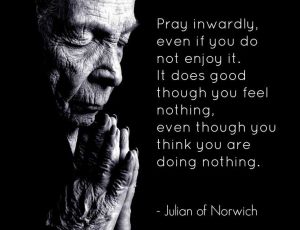
Likewise, our prayers are not always laden with strong emotions. Sometimes we may not “feel” anything, but we pray on because it is time to be with God. We pray out of devotion and duty and love. We pray because we are Christians.
Number 5: Say the words that need to be said, especially on your worst days.
Don’t forget to say “I love you,” and “thank you,” and “please,” and “I couldn’t do this without you,” and all the other small-big things that are too easily forgotten. I’m especially bound to forget these things when I’m upset or frustrated. But our words matter, and we need to tell our loved one certain things–even if, and especially if, we just aren’t feeling it that day. (This goes back to point 4: sometimes you have to put your emotions aside.)
There are days I don’t feel like praying. Or if I do pray, I am tempted to rush through the Lord’s Prayer or the collect for the day–I know these prayers so well that it’s easy to rush through without thinking. But it’s important to say those prayers daily.
Why? Because our words matter. Our words, repeated day after day, form us at a deep level. The more we say, give us this day our daily bread, the more we remember that we really do depend on God for our daily strength. The more we say, I love you, the more we recall how much we love God or that special someone in our lives.
I’m so thankful to Molly for these lessons. Our relationship has indeed drawn us closer to God. And that’s what marriage is supposed to be about. Marriage is a reflection of the love of Christ for the Church and a foreshadowing of the Last Day when that union will be made complete. The love of marriage, then, should draw us into the depthless love of God. As we grow closer to our partner, we grow closer to our Maker.
So what more shall we say? Nothing new. But something true. Something ancient. Something divinely revealed to us that is so much greater than us. We believe in one God: the Father, the Son, and the Holy Spirit. And having confessed it by faith, we live it.
SERMON THE FEAST OF THE HOLY TRINITY St. Thomas’ Episcopal Church Springdale, AR Readings: Genesis 1.1-2.4a, Psalm 8, II Corinthians 13.11-13, Matthew 28.16-20
In the Name of God: Father, Son, and Holy Spirit. Amen.
Today is Trinity Sunday, the first Sunday after Pentecost. The Easter lilies, long out of bloom, are now a distant memory. Christ has died, been raised by God, and ascended into heaven to sit at the right hand of the Father. And as Jesus promised, the Comforter, the Holy Spirit, has indeed come among us, to guide and sustain us. We have entered the longest season of the Church year–the season after Pentecost–during which we will focus on the teachings of Jesus during his earthly ministry. And to kick things off, we have the Trinity, the cornerstone of the Christian faith and life, the mystery of one God in three persons: Father, Son, and Holy Spirit.
The Trinity is eternal, from everlasting, greater than and outside of time itself. In our reading from Genesis this morning, we see the Holy Trinity at work (Gen 1.1-2.4a). God the Father is at work in creation, guiding creation from nothingness to fullness, from a formless and dark void to light, to evenings and days, to seas and dry lands, to green vegetation and flowers and animals of all kinds, and finally to us, a people created in God’s very creative and life-giving and loving image. And we read that all of this is brought forth from the Word as creation is spoken into being. The opening to John’s Gospel reads, “In the beginning was the Word, and the Word was with God, and the Word was God” (Jn 1.1). And it is this very Word, eternally begotten of the Father, God from God, Light from Light, true God from true God–this Word will become incarnate from the Virgin Mary, to share our human nature, to live and die as one of us, and to reconcile us to God our Father. And we also see the Holy Spirit at work: A wind from God is sweeping over the face of the waters (Gen 1.2). This wind is the ruach, the breath, the spirit of God that was hovering, brooding over this creation-to-be. This is the wind we heard about last week, the Comforter Jesus had promised when he ascended to the Father: “When the day of Pentecost had come, the disciples were all together in one place. And suddenly from heaven there came a sound like the rush of a violent wind, and it filled the entire house where they were sitting” (Acts 2.1-2). This is the unpredictable fire of God that birthed the Church and catches us up in wonder still.
We see the Trinity at the baptism of Jesus in the Jordan. Jesus, the Son of God, the Word of God, comes to the Jordan to be baptized. And as he is, the heavens are torn open, God the Father speaks, “This is my Son,” and the Holy Spirit descends on him like a dove (Mk 1.9-11; Mt 3.16-17; Lk 3.21-22).
And it is this God in Trinity that Paul speaks of today as he blesses the people of Corinth: “The grace of the Lord Jesus Christ, the love of God, and the communion of the Holy Spirit be with all of you” (2Cor 13.13). This is the only instance where Paul blesses his readers with such an overt and clear trinitarian blessing, invoking all three persons of the Trinity.
Of course, the doctrine of the Holy Trinity as we understand it would come later, as faithful people wrestled with the testimony of the Scriptures and the Christian life, and as God revealed the mystery to them.
The word “revealed” seems to me to be of the utmost importance. The Trinity is not something clever that the Church came up with on its own. No, it is God’s revelation to us about who God is: One Being in three persons whom we have come to know and love and worship: Father, Son, and Holy Spirit. The One God testified to in the Scriptures, and the three persons also testified to in the Scriptures.
Long ago, our Church fathers and mothers wrestled with the question of the Holy Trinity. They structured our creeds around it. So everyday at the Daily Office when we say the Apostles’ Creed, we say, I believe in God, the Father…the Son…the Holy Spirit. And every Sunday at worship, we say the words of the Nicene Creed: We believe in one God, the Father… the Son… the Holy Spirit. And it is in these creeds and the Athanasian Creed that the Church has articulated what has been revealed to us about the Trinity by God.
What more shall we say? Truly, there is nothing left to say. Sometimes we have this urge to say something new, but there is nothing new under the sun–certainly nothing new about the Holy Trinity. And it is this impulse to say something new that can sometimes get us into trouble. Sometimes, even for the best reasons, we might say something outside the bounds of Christian doctrine–something other than what God has revealed to us.
Maybe you have seen that viral video on the Internet about St. Patrick and the Trinity? St. Patrick, the patron saint of Ireland, tries to explain the Trinity to a couple of seemingly backward Irishmen with crazy red hair. St. Patrick turns to metaphor: the Holy Trinity is like a clover with three branches but one stem, or like water that can be liquid, solid, or gas, and on and on. It’s so hard to explain a mystery of heavenly things with earthly things–you can’t explain it! So at each turn the Irishmen respond, no Patrick! Seemingly there is nothing Patrick can say except the words of the Athanasian Creed: “We worship one God in Trinity, and Trinity in Unity, neither confounding the Persons, nor dividing the Substance.” “Oh,” the Irishmen respond, “Why didn’t you say so, Patrick?”
What more shall we say, aside from the creeds, these gifts from God to Christ’s Church? Perhaps, as one English theologian wrote, silence is our safest eloquence for we mortals before the deep mystery of who the infinite God is (see Richard Hooker in Book I of Laws, cited in Rowan Williams, Anglican Identities (Lanham: Cowley Publications, 2003), 25-26).
So what more shall we say? Nothing new. But something true. Something ancient. Something divinely revealed to us that is so much greater than us.
We believe in one God: the Father, the Son, and the Holy Spirit.
And having confessed it by faith, we live it.
When we are baptized, we are adopted as children of God the Father and as brothers and sisters of Christ Jesus. We are invited to live in, to participate in the Life of the Trinity. And the Life of the Trinity is Love–boundless, endless, depthless, infinite Love of such generosity and vastness that it is constantly being poured out completely, yet it is never depleted by a single ounce. It is an unconstrained Love that breaks every barrier, that will never leave us, even as we pass from life to death. It is this Love that we receive, and it is only from this Love that we can love others. We can only love because God loves.
I was at a camp once talking to some young children, maybe around seven or eight years old, about the Trinity. There was one girl there who did not want to be there–or so it seemed. She sat there in some far-off la-la land, braiding her hair, fidgeting with her socks, untying and retying her shoes, messing with an ant that happened to be crossing the sidewalk. But then again, we were talking about the Trinity. Maybe she just wasn’t interested? She wouldn’t be the first child to find the subject confusing, or boring, or dull, or whatever. After we had all talked for awhile, I passed out some markers and paper, and we tried to draw a symbol for the Trinity. Some children drew venn diagrams of three overlapping circles; others drew triangles a lot like the triangle in the window above our altar here. The girl jotted something down, then turned the paper over and began to draw horses. Well, okay. You can’t win ‘em all. After a period of time we shared our drawings. I hesitated when I got to the little girl, not wanting to embarrass her. But she immediately stood up and brought her drawing over to me. She had drawn a big circle with four small, parallel lines in it. “Will you tell me about your drawing?” I asked. “Sure,” she replied. “The big circle is God, and inside it is the Father, the Son, the Holy Spirit, and me.”
The Father, the Son, the Holy Spirit, and me. I don’t know what Athanasius or Augustine or Aquinas would have said about her drawing. But in ten seconds of minimal effort she had got to a deep mystery. The infinite God invites us into God’s very Life of Love.
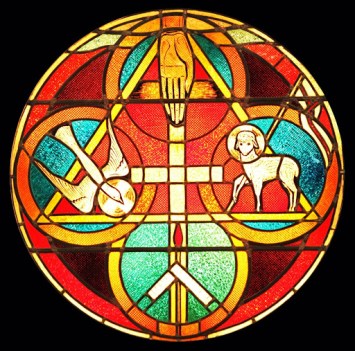
A representation of the Holy Trinity in the window above the altar and on the bishop’s cathedra at St. Thomas’ Episcopal Church in Springdale, Arkansas. The hand represents God the Father, the lamb God the Son, the dove God the Holy Spirit, and the carpenter square and spear St. Thomas.
Our own image of the Trinity here at St. Thomas’ does this in a different way. In the window above the altar, you can see a triangle within a circle, with each corner of the triangle representing a person of the Godhead. But coming from the heart of that triangle, from the heart of God, is a cross reaching down to us, bringing us to God. And that’s fitting, for the way of living in the Life of the Trinity is the Way of the Cross.
In our baptisms we are buried into this Life of Love, and then each day we take up our cross to live into this Life of Love all the days of our lives. We live in a Love that is overflowing and abundant, sacrifices all and never asks for anything in return; a love that is unconditional, complete, brave and bold and sure and vulnerable and open and willing to take a risk on you.
We can get a glimpse of what it looks like to live into this Life of Love in the eyes of the old woman who lives alone on the corner now, a block over from the old courthouse–maybe you know someone like her. Her name is Lucille, and she’s well into her nineties. She couldn’t be taller than four foot eight. Her husband died several years ago now. She has lived in the same house for well over fifty years; it’s foundation could use some work, the gutters could be cleaned, the shutters repainted. When you pass by, you’ll see her gardening, watering her ferns, sometimes even mowing her yard, or just sitting on the porch with a cup of coffee or a glass of lemonade. Or maybe you’ll pass by late at night or early in the morning; she doesn’t sleep much anymore. She’ll be kneeling at her couch with her Bible open, praying to God her old friend, calling out the names of her loved ones. Or you might see her on the square downtown, holding a basket of peanut brittle that her church sells to raise money. “The peanut brittle lady is here,” the courthouse employees will tell one another. They’ll go find her, usually sitting on a bench in the shade. These strangers will go for a bag of homemade peanut brittle, a bargain at $3. But they’ll get the warmest smile; they’ll hear her quiet laugh; they will hear her say, “I just love God so much, I love my little church, and I love you”; they’ll get a weak and frail yet powerful hug full of love. They will feel as if they have known her forever, even though they have just met; she’ll remind them of their grandparents and parents. The strongest and most hardened people will melt. They get more than they bargained for. They get a dose of the love of God.
I go by and see her when I’m in town. I drive up and see her sitting on her porch. Whenever she sees me coming, the biggest smile spreads across her wrinkled face. “I just love you so much,” she will say with a little laugh. “You know, I’ve been praying for you.” And you know she has, because you can feel it deep within your soul.


 Storied Grace