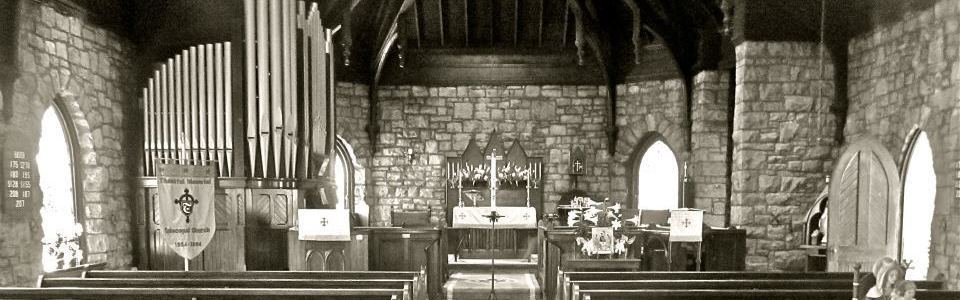
A sermon preached at Thankful Memorial Episcopal Church, Chattanooga, Tennessee, on the 7th Sunday of Easter, Year B, and Mother’s Day.
Readings: Acts 1:15-17, 21-26; Psalm 1; I John 5:9-13; John 17:6-9
In today’s Gospel reading, Jesus is saying goodbye to his disciples. He is praying that God will give his disciples–and us–strength to be witnesses of Jesus Christ. And it does take strength. Jesus’s prayer says that just as he was in the world but not of the world, so, too, are we in the world but not of the world. We are separate from the world somehow, even if we live in it, because we are united to God through Christ.
“They do not belong to the world,” Jesus prays, “just as I do not belong to the world” (Jn 17.14). It is easy to see how Jesus did not belong to the world. In the beginning of John’s gospel, we read that Jesus “was in the world, and the world came into being through him; yet the world did not know him” (Jn 1.10). Throughout his life, he moves in a different plane. As fully human, he lived like us, with both suffering and joy. But he was also fully God. And that means Jesus’s relationship to God the Father was a little different from ours. Their relationship was so close, so intimate and personal and connected. And people picked up on this. People could see that Jesus did not belong to the world. He belonged to God, and God alone.
Jesus is calling us to this. We are called to this relationship with God, through Christ. We are called to belong fully to God; we do not belong to this world.
Growing up, my mother showed me what it is like to be connected to God in this way–or at least, as much as we can now. My mother lived in the confidence that Jesus was always just a breath away from her. As a single mom in college for much of my childhood, her confidence in God could not be theoretical. She depended on God, in a real way, for real needs.
One Sunday night, we were driving home from church. I couldn’t have been older than seven. The little church was out in the country, and we had to take a winding state highway back to the town where we lived. That particular night, we rounded a corner, and there was a deer. I’m sure it’s an experience most of us have had. Mom slammed on the brakes, but it was too late. As the deer crushed the front of the car and hit the windshield, the only thing I remember is Mom saying, Jesus. I suppose there were a lot of things she could have said. But her instinct was to pray the shortest prayer she could spit out in that split second. Her first line of defense was to breathe the name Jesus.
Mom sings all the time, sometimes without knowing it. One of her favorites is “What a Friend We Have in Jesus.” It fits her. One of the lines in that hymn is that we should take “everything to God in prayer.” And she’s not bashful about this. Even today, when I say I have a problem or worry, her response is often, “Well, have you prayed about it?” And there aren’t many things she hasn’t prayed for. She prayed when we hit the deer. She once prayed over a car that couldn’t be fixed for a while, but needed to make it through a trip. And I know she prays for Molly and me. We can feel her prayers.
In a real way, Mom’s citizenship is not in this world. It is in heaven. She belongs to God, and God belongs to her. She still lives in the world: she goes shopping, she pays her bills, she works. But her eyes are toward God.
This is what God wants from us. God desires for us to be in close relationship with God, to be drawn up into the life of God. And today, this is what Jesus prays we might experience. Jesus acknowledges that his disciples, his closest friends, are not his, but are God the Father’s. They are a gift to Jesus from his Father, and just like Jesus, they belong to the Father. The same is true for us. We belong to God as God’s own beloved children.
I have heard it said that if we want to see the love of God, we should look at the love of mothers for their children. I think that’s true with me. And for many, that’s how they understand the love of God. Children belong to their mothers, forever. The children may be great or not. They may be wonderful role models or get into trouble. But they still belong to their mother.
I heard a story recently about a mother with two sons. One son was the valedictorian of his class, went to college, had an internship at NASA, and went on to a successful career and to have a family of his own. His mother loved him very much. But the other son had some troubles. He had a problem with addiction, even at times stealing money from his mother to support his habit. His mother loved him very much, too. When the older brother asked her about it, she said that she had no illusions about the challenges her youngest son faced. She could see plainly the damage he was doing to himself and others, including her. But she loved him. And she always would. And he would always have a place at her table.
So maybe it’s true much of the time: If you want to see the love of God, look to the love of a mother. But sometimes people are hurt by their mothers, whether by absence or neglect or abuse. I once met a young woman in the emergency room when I was working as a hospital chaplain. Her name was Paige. She was there with her mom, who was dying. When I asked how she was doing, she said she didn’t know what to feel. Her childhood had not been a good one. She was neglected by her mother, and eventually abandoned. She had only reconnected in the last few weeks as her mother’s condition worsened. This young woman, now a mother of two of her own, looked over at me, with tears running down her cheeks. She said, “You know, the worst of it is, I was so scared of being a mother. I was afraid I would not be able to take care of my kids, like my mom. I’m still scared.”
So I asked, “What made you change your mind, Paige?”
“I became a Christian. And I learned how to be a mother from God.”
She learned what love looked like from God. She learned what acceptance looked like from God. She learned what forgiveness looked like from God. She learned what motherhood looked like from God. She learned that she had the strength and courage to love as a mother, because God loves her. And God, the mother of us all, loves us, too. Fiercely.
I think this is part of what it means not to be of this world. In this world, love has conditions. Belonging has its limits. We experience our own shortcomings and the shortcomings of other fallen human beings. But not so with God. We belong to God, forever and always. The love of God is boundless.
That is the world we are called to live in. We are called to be bound up in God, to live in God’s love, to base our decisions and go about our lives with a different world in mind. We are not of this world, with its limits and shortcomings and failings. And thank goodness. We are of God. We belong to God. We live in God.
We are in this world, but we are not of this world. And because of that, we can love with an otherworldly love. We can dare to love with the very love of God.
 Storied Grace