
Life-giving God, Your Call to Serve
This text was written to commemorate the retirement of the Rt. Rev. J. Neil Alexander as the 14th Dean of the School of Theology at the University of the South: Sewanee. I was blessed to be a seminarian there under his leadership. The text is inspired by Psalm 133, the University’s motto, as well as Romans 12, a source of inspiration for Bishop Alexander’s standard blessing at the end of the liturgy.
Life-giving God, your call to serve
has brought us here to learn and pray;
once sealed and marked with grace unearned
we seek your grace on this new way.
How good and pleasant it will be
for us to live in unity:
A unity to tell of how
our Savior Christ came here to save,
whose arms outstretching even now
draw all the world to your embrace,
whose risen life now makes us free
to love and serve you endlessly;
A unity in truth to speak
courageously against all wrong;
and in your justice and your peace
to lift the faint, the weak make strong;
and in your love, a faith to share,
a joy to live, a hope to dare.
So now we lift our hearts to you
a living sacrifice of praise.
Pour out your grace like oil and dew;
anoint and send us to proclaim
your promised life forevermore,
united in our living Lord.
Words: Mark Nabors (b. 1990)
Music: Curlicue, Kenneth Miller (b. 1989)
88. 88. 88
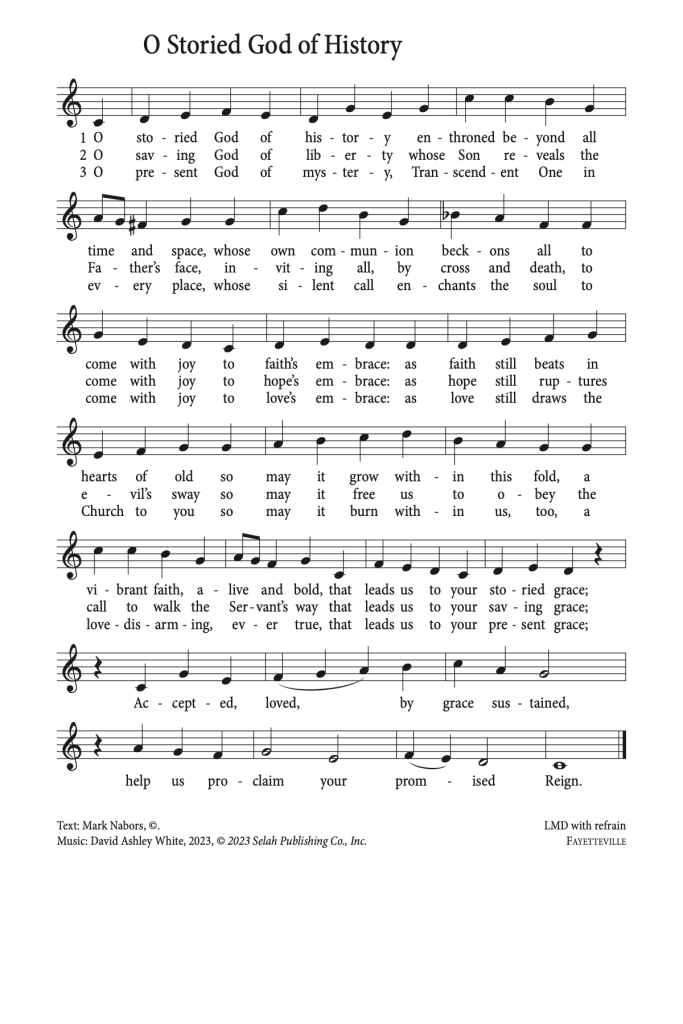
O Storied God of History
This text was commissioned by St. Paul’s Episcopal Church in Fayetteville, Arkansas, to celebrate its 175th anniversary in May 2023. St. Paul’s holds a special place in my heart, since it was the place that I was baptized and confirmed on May 2, 2010. It was a real honor and delight to write this text.
The text centers on St. Paul’s famous triad, faith, hope, and love, rooted in that inescapable Pauline theological theme of grace. Like all of my texts, it is a prayer that God would help us grow more, day by day, into those theological virtues that are rooted in God’s gracious Being. The refrain turns us to something new: a commissioning to share the gift we have been given with those around us. It is a paraphrase of St. Paul’s mission statement: to explore and celebrate God’s infinite grace, acceptance, and love. Astute readers will also notice the traditional trinitarian pattern embedded in the text.
The tune was composed by the accomplished David Ashley White. It was a privilege to work with someone of his stature in the field. His wonderfully singable tune, Fayetteville, captures well the turns in the text. Given the text’s unusual meter (LMD with refrain), this was a challenge.
 Storied Grace